Transport Stack Hackathon 2026 Delhi: Prizes, Dates & Problems
6 min read
●
19 November 2026
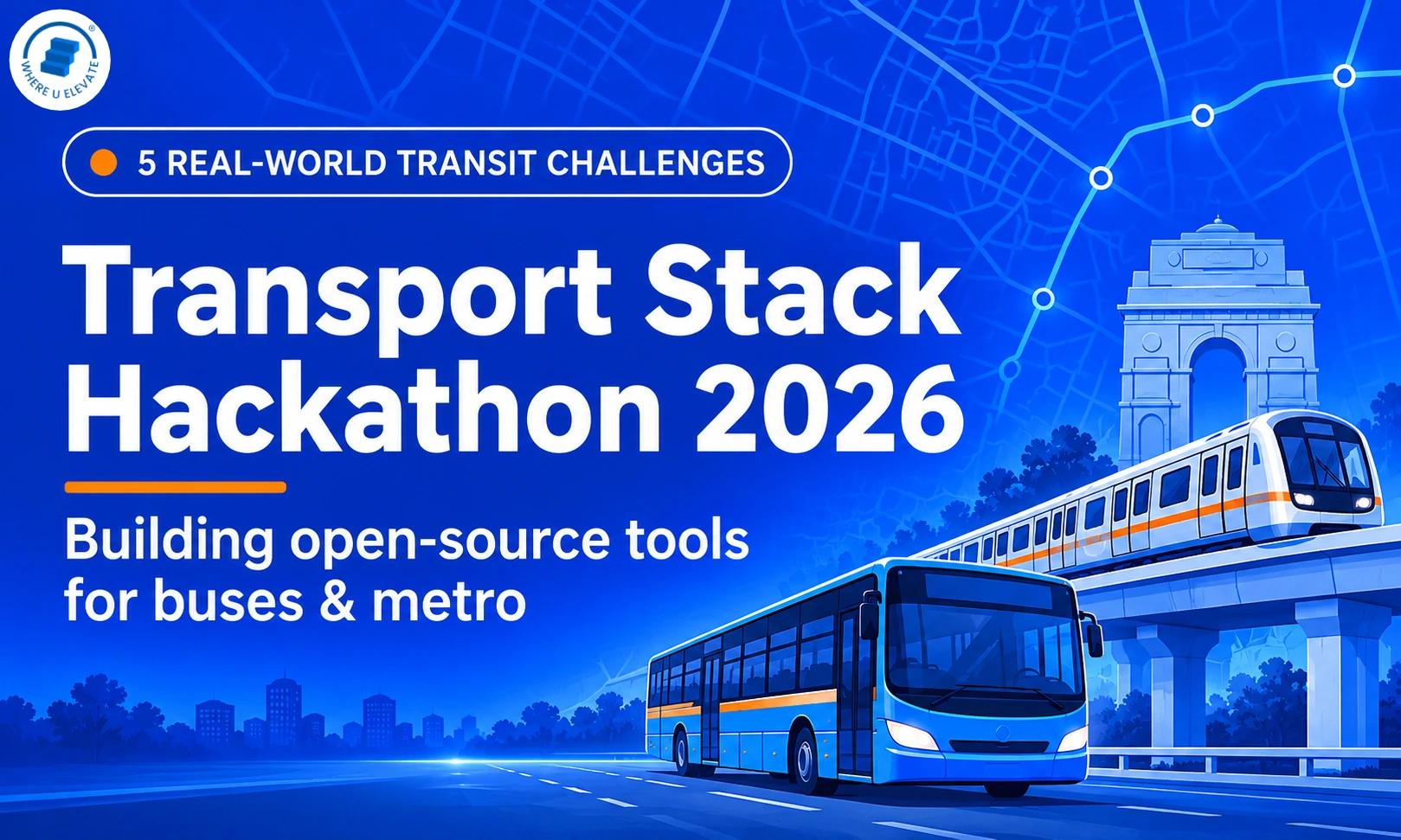
Join Transport Stack Hackathon 2026 in Delhi! Win ₹2.75 lakh, solve real-world mobility challenges and register your 2–3 member team by 20 Nov.
Transport Stack Hackathon 2026 offers ₹2,75,000 in prizes to teams of 2–3 building on real Delhi transit data. Team registration closes on 20 November 2026 at 23:59 IST on Where U Elevate.
Transport Stack Hackathon 2026 at a glance
Detail | Information |
| Event | Transport Stack Hackathon 2026, Delhi |
| Team size | 2–3 members |
| Prize pool | ₹2,75,000 |
| Registration closes | 20 November 2026, 23:59 IST |
| Format | Phases 1 and 2 online; final round hybrid |
| Final round | 11 December 2026, 10:00 AM–2:00 PM IST, IIIT Delhi, Okhla Phase III, New Delhi |
| Registration platform | Where U Elevate |
What is the Transport Stack Hackathon 2026?
Transport Stack Hackathon 2026 is an open innovation competition for building technology solutions for Delhi's public transport network using real bus GPS, e-ticketing, Electronic Ticketing Machine (ETM) and metro Automatic Fare Collection (AFC) data. Teams of 2–3 compete for ₹2,75,000.
Although this hackathon in Delhi 2026 ends with a final round at IIIT Delhi, the two build phases are online. Standout solutions may be taken forward as open-source components of Transport Stack; the event pages do not guarantee deployment.
What is the Delhi Transport Stack?
According to JICA's overview, Delhi Transport Stack aims to build a multimodal ecosystem with data interoperability for metro, bus, rail, micro-mobility and services such as parking and EV charging, using secure open APIs. JICA's launch announcement of 19 November 2024 says it offers real-time and static datasets through partnerships with more than 10 agencies, including DMRC, DTC and DIMTS. JICA describes Delhi as having twelve Metro lines and more than eight thousand buses.
The platform has run an innovation call before. JICA's February 2025 announcement confirms that five winning teams from the Transport Stack Open Innovation Challenge moved on to proof-of-concept work in Delhi's transport ecosystem.
According to the Where U Elevate event listing, the 2026 hackathon is associated with Transport Stack, an initiative by JICA, and involves Chartr, the Centre for Sustainable Mobility at IIIT Delhi and Airawat Research Foundation, IIT Kanpur. Chartr is a startup incubated at IIIT-Delhi.
Five problems in the Delhi Transport Stack Hackathon
Problem details below follow the official event page.
Phase 1: Open to every registered team
- Problem 1, Bus travel-time planner: Build a traffic model from real-time and historical bus location data, then expose a Google Maps-like API that estimates bus travel times between any two locations.
- Problem 2, Crowdedness-aware planner: Estimate crowdedness by route and time of day from about 4–5 weeks of e-ticketing and ETM data, then show it inside a journey planner.
Phase 2: Shortlisted teams refine Phase 1 or choose Problem 3, 4 or 5
- Problem 3, Public transit OD matrix: Bus e-ticketing captures only 3–4% of bus tickets, so teams scale that sample to full ridership using the denser metro gate data.
- Problem 4, Metro feeder routes: Design feeder routes for about 500 electric buses, with a maximum route length of 7 km, traffic conditions accounted for, and a feasible charging plan. The official page says to use only roads wider than 6 metres on each side; check the full problem brief for the exact definition.
- Problem 5, Metro and bus crowding: Estimate passenger load by route, segment and time of day from about one month of AFC boarding and alighting records.
Datasets available to teams
Teams sign up at delhi.transportstack.in and request the datasets and API keys their problem needs. The listing names:
- Real-time bus positions (GTFS-RT) for DTC and cluster buses, updated every few seconds
- Historical bus GPS traces covering several weeks
- Static bus GTFS with about 10,500 stops, 2,400 routes and 89,000 scheduled trips
- E-ticketing and ETM data covering 4–5 weeks
- Metro entry and exit gate data
- About one month of AFC boarding and alighting data
- Road network data and the target metro station list for Problem 4
How each dataset can be used:
- GTFS-RT supports real-time bus location work.
- Historical GPS traces can support travel-time prediction and route analysis.
- ETM and ticketing records can help estimate passenger demand and crowding.
- AFC data gives boarding and alighting records for understanding travel patterns.
- Road network data supports geospatial route optimization and feeder connectivity.
What skills help, and why the problems are technically interesting
These are public transport and smart mobility problems, so useful skills include data engineering, geospatial analysis, predictive modelling and machine learning, optimisation and API development.
- Travel-time prediction combines temporal and geospatial analysis of bus GPS traces.
- Crowding estimation means interpreting passenger transaction records, not direct passenger counts.
- OD modelling has to correct for a 3–4% sample and state where uncertainty is highest.
- Feeder planning combines spatial constraints, metro demand, fleet size and charging limits.
- Load estimation means reconstructing on-vehicle movement from boarding and alighting records.
How submissions are judged
Judging is indicative and covers problem relevance, technical depth and correct use of the data, feasibility, innovation, and usability and impact. Every submission needs source code with a README, a short technical note and a short demo video. Mock-only or slide-only entries do not qualify. Work must be original, and open-source libraries are allowed if credited.
Important dates and participation timeline
Registration closing and prototype submission closing are two different deadlines.
Milestone | Date | What happens |
| Team registration closes | 20 November 2026, 23:59 IST | Teams register and add members; datasets and access details follow registration |
| Phase 1 prototype submission | 29 October to 24 November 2026, 11:59 PM IST (per the Where U Elevate timeline) | Proposal, working prototype and code repository URL |
| Phase 2 build sprint | 25 November to 9 December 2026 | Shortlisted teams only, with weekly mentor sessions |
| Final round | 11 December 2026, 10:00 AM–2:00 PM IST | Presentations, judging and winners at IIIT Delhi |
How to register for the Transport Stack Hackathon 2026
- Register your team on Where U Elevate by 20 November 2026, 23:59 IST. One member registers the team and adds the others.
- Sign up on the Delhi Transport Stack platform and request your datasets.
- Pick Problem 1 or Problem 2.
- Submit your proposal, working prototype and code repository URL before Phase 1 closes.
- If shortlisted, refine your solution or take on Problem 3, 4 or 5. Teams meet mentors for 10–15 minutes every week. The listing expects about 10–12 teams to be shortlisted from 200+.
Why participate through Where U Elevate?
Where U Elevate is a platform for hackathons and innovation challenges that connects students, developers and institutions with organisers. For this event, it hosts the event listing, the timeline and team registration, so teams can find the details and register in one place.
Frequently Asked Questions (FAQs)
1. Who can participate in the hackathon?
Students, researchers, startups and working professionals from India and abroad can participate. Each team must have 2–3 members, with one member registering the team and adding the others.
2. Is the hackathon free to participate in?
Yes, the Transport Stack Hackathon 2026 is completely free to participate in. Interested teams can register through Where U Elevate without paying any registration fee.
3. What is the last date to register?
The last date for team registration is 20 November 2026 at 11:59 PM IST. Participants must complete their registration through Where U Elevate before the deadline. Prototype submission follows a separate timeline.
4. What are the hackathon problem statements?
The hackathon features five challenges focused on public transport innovation: bus travel-time prediction, crowding-aware journey planning, public transit OD matrix development, metro feeder route optimisation, and passenger load estimation using transport data.
Comments
No comments yet. Be the first to comment!