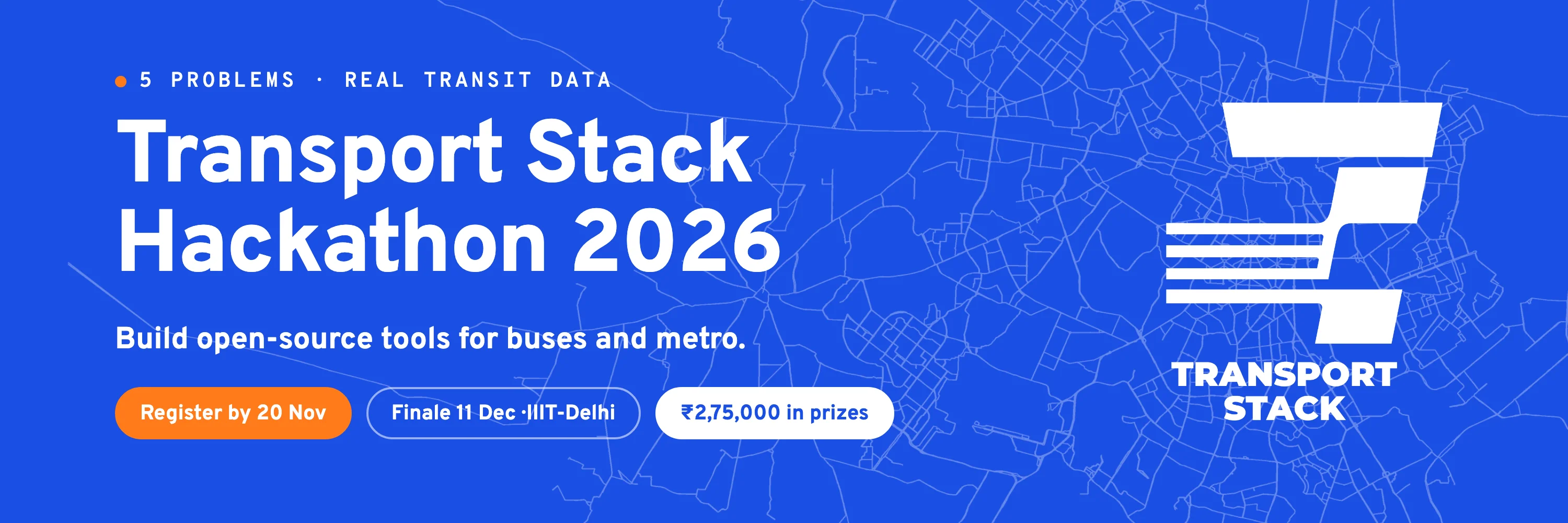
Transport Stack Hackathon 2026
Delhi Transport Stack
Free
98Registered
2 - 3Team Size
275000Prizes
9 D : 7 H : 26 MRegistration ends in
1637Impressions
Join our Discord Community

Transport Stack Hackathon 2026
Delhi Transport Stack

Key Highlights
Description
The Transport Stack Hackathon 2026 invites teams to build open-source tools using real transit data. It is organized by Transport Stack - an initiative by Japan International Cooperation Agency (JICA), run by Chartr with the Centre for Sustainable Mobility (CSM), IIIT D and owned by Airawat Research Foundation (ARF), IIT Kanpur.
Teams work on five problems built on real Delhi transit data: live bus GPS, e-ticketing, Electronic Ticketing Machine (ETM) records and metro Automatic Fare Collection (AFC) records. The problems range from predicting bus travel times and estimating crowding to building a city-wide origin–destination matrix and planning feeder bus routes for metro stations.
The hackathon runs in two online phases. In Phase 1, every registered team pick Problem 1 or Problem 2 and submits a proposal with a working prototype. Shortlisted teams move to Phase 2, where they refine their Phase 1 work or take on Problem 3, 4 or 5 over about two weeks, with mentor sessions. Phase 2 solutions are presented and judged at the Transport Stack Annual Event at IIIT Delhi on 10 December 2026, where the winners are announced.
The best solutions may be taken forward as open-source components on Transport Stack.
Full problem briefs: https://delhi.transportstack.in/hackathon/
Eligibility
Stages & Timeline
Phase 1: Prototype Submission
Online
Start on:
29 Oct '26, 4:30 AM IST
Ends on:
24 Nov '26, 6:29 PM IST
Open to all registered teams. Pick Problem 1 or 2 and submit a proposal, a working prototype and working code repo URL.
Phase 2: Build Sprint
Online
Start on:
24 Nov '26, 6:30 PM IST
Ends on:
9 Dec '26, 6:29 PM IST
Refine the Phase 1 solution or take on Problem 3, 4 or 5, over about two weeks, with a short mentor session every week. No on-site building round.
Phase 3: Final Round and Winner Announcement
Hybrid
Start on:
11 Dec '26, 4:30 AM IST
Ends on:
11 Dec '26, 8:30 AM IST
 IIIT Delhi, Okhla Phase III, New Delhi
Shortlisted teams present their Phase 2 solutions; judging and winners announced at the Transport Stack Annual Event.
Guidelines
Resources
Hackathon page and full problem briefs: https://delhi.transportstack.in/hackathon
Delhi Transport Stack platform (sign up and request datasets and API keys): https://delhi.transportstack.in
Datasets available for the hackathon:
• Real-time bus positions (GTFS-RT) for DTC and cluster buses, updated every few seconds
• Historical bus GPS traces covering several weeks
• Static bus GTFS: about 10,500 stops, 2,400 routes and 89,000 scheduled trips
• E-ticketing and ETM data covering 4–5 weeks
• Metro entry and exit (gate) data
• About one month of AFC boarding and alighting data
• Road network data and the list of target metro stations (Problem 4)
Questions about problems or data: transportstack.hackathon@gmail.com
Problem Statement
Problems
2 Problem Statements
01
Real-time bus traffic model and journey planner
Delhi's buses generate continuous location data across the city's road network. Build a traffic model from real-time and historical bus location data ...
02
Crowdedness-aware journey planner
Crowdedness shapes how commuters experience a trip, yet journey planners ignore it. Build a model that estimates crowdedness across bus routes and tim...
FAQs
Students, researchers, startups and working professionals, in India or abroad, in teams of 2-3 members.
No. Participation is free.
Pick either Problem 1 (bus travel-time planner) or Problem 2 (crowdedness-aware planner). Problems 3, 4 and 5 open to shortlisted teams in Phase 2.
Sign up on the Delhi Transport Stack platform at https://delhi.transportstack.in and request the datasets your problem needs.
A proposal, a working prototype, source code with a README, a short technical note and a short demo video. Mock-only or slide-only submissions do not qualify.
No. Both phases are online. Shortlisted teams present at the Transport Stack Annual Event at IIIT Delhi on 10 December 2026.
About 10–12 teams will be shortlisted.
Shortlisted teams have about two weeks to refine their Phase 1 work or take on Problem 3, 4 or 5, with a short mentor session every week.
On problem relevance, technical depth and correct use of the data, feasibility, innovation, and usability and impact. Each brief lists its own success criteria.
Yes, as long as they are credited and the solution is the team's own work.
Teams keep credit for their work. Standout solutions may be taken forward as open-source components on Transport Stack.
For problems and data, email transportstack.hackathon@gmail.com. For registration and platform issues, contact the Where U Elevate helpdesk.
Yes. Declare your team size first, and then add your members’ details. The form follows the 2-3 member limit and won’t accept a team outside that range.
Refer and Earn
Refer your friends to participate in exciting hackathons.

Key Highlights
Refer and Earn
Refer your friends to participate in exciting hackathons.