Hackathon Organizing Company in India: What End-to-End Management Actually Includes
15 min read
●
10 June 2026
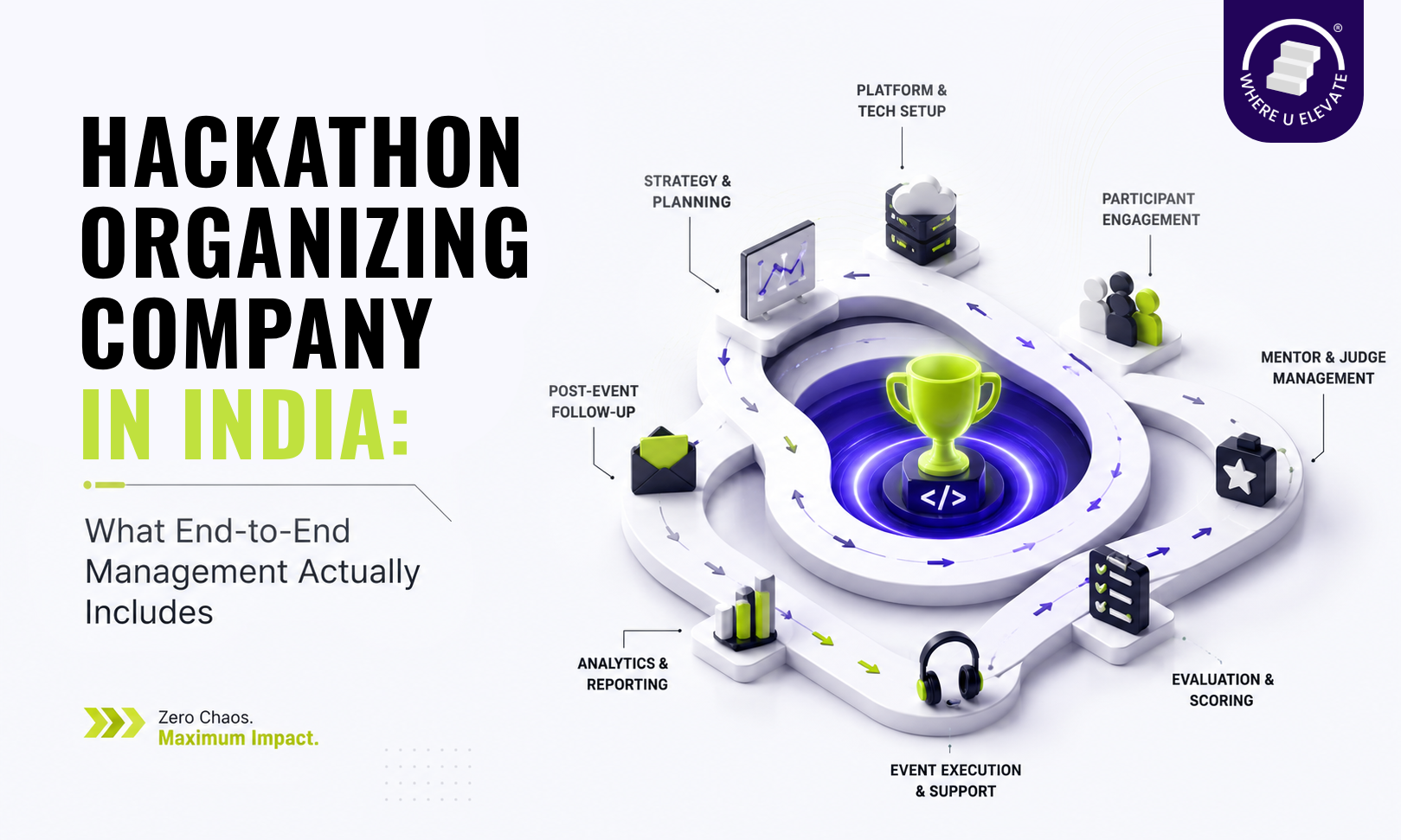
Choosing a hackathon organizing company in India? Learn what end-to-end management includes and how it impacts participation, hiring, and ROI.
Most Enterprises Run Hackathons. Very Few Run Systems.
If you are an HR leader, CXO, or procurement head who has run a hackathon internally - or evaluated one and walked away with nothing actionable - you already know the gap this article is about.
The registrations looked strong. The event ran. The prizes were distributed. Then your hiring team asked for the shortlist and there was nothing structured to hand them. No evaluated pipeline. No documented performance signals. No conversion path from winner announcement to first interview.
That is not an execution failure. That is a design failure.
The organizations consistently generating qualified talent pipelines, validated innovation inputs, and measurable employer brand lift are not running better events. They are running fundamentally different infrastructure - with the same design rigor and outcome measurement they apply to any core business process.
That is the real mandate of a modern hackathon organizing company in India. Not logistics. Not event coordination. Full-stack talent and innovation infrastructure - designed, executed, and measured to produce commercial outcomes your hiring managers, innovation leads, and CFO can all act on.
Book a Demo:- https://whereuelevate.com/book-a-demo
What a Hackathon Organizing Company in India Actually Is
The Definition Decision-Makers Need: A hackathon organizing company in India is a full-stack talent and innovation infrastructure provider that manages the complete program lifecycle - from strategic design, platform technology, and multi-channel participant acquisition through evaluation architecture, fraud prevention, and post-event hiring or innovation conversion - delivering measurable business outcomes rather than event deliverables.
This definition matters because it draws a hard line between two fundamentally different vendor categories:
General Event Agency | Hackathon Organizing Company |
| Manages logistics | Manages outcomes |
| Optimizes for attendance | Optimizes for conversion |
| Delivers event reports | Delivers talent pipelines |
| Per-event coordination | Persistent infrastructure |
| Cannot evaluate talent | Built to evaluate talent |
| No post-event system | Structured conversion pipeline |
Selecting the wrong category is the single most expensive mistake enterprises make in hackathon investment - and it happens at the briefing stage, before a single rupee is spent.
Why Enterprises Are Shifting to Structured Hackathon Programs
Three commercial pressures are driving this shift simultaneously:
Talent acquisition is broken at the top of the funnel. Traditional hiring pipelines are slow, expensive, and structurally weak for technical and innovation roles. Hackathons create pre-evaluated talent pools based on real problem-solving performance - not resume screening.
Employer branding requires proof, not presence. MNCs and fast-growing companies compete intensely for attention in high-value student and developer communities. A well-executed hackathon creates documented, measurable brand presence in those communities. A poorly executed one creates the opposite.
Innovation pipelines need external input. Internal R&D teams operate with structural blind spots. Hackathons create organized external ideation channels with diverse perspectives - at a fraction of the cost of traditional research programs.
All three outcomes are available from a single well-designed program. But only if the program is designed as a system, not assembled as an event.
The 8-Layer Execution Framework
Definition: End-to-end hackathon management is the structured execution of eight interconnected operational layers - strategic design, technology infrastructure, participant acquisition, lifecycle engagement, evaluation architecture, fraud prevention, showcase execution, and post-event conversion - in which the commercial output of every layer depends directly on the quality of every layer before it.
This is the framework that separates infrastructure from coordination. Here is what each layer covers, where programs break, and what strong execution produces.
Layer 1 - Strategic Program Design
The business alignment layer. The most critical. The most ignored.
Most organizations delegate this to marketing or HR coordination teams who optimize for reach because reach is fast and measurable. The result: a well-distributed program with the wrong participants - high volume, low intent, zero conversion.
Strategic design treats the hackathon as a business product. It defines:
- Business objective: hiring pipeline, innovation sourcing, or employer brand - each demands a different architecture
- Problem statement design: calibrated to attract the exact talent or ideation profile required
- Format selection: online, hybrid, campus-based, multi-stage, or always-on continuous
- Participation eligibility: ICP targeting before distribution begins
- Success metrics: conversion-ready candidates, viable concepts produced, qualified community impressions - not registration counts
Operating principle: A hackathon with 500 deeply engaged, domain-aligned participants consistently outperforms one with 5,000 passive signups. Design determines which outcome you are building toward - before a single registration opens.
Layer 2 - Technology Infrastructure
The operational backbone. Invisible when working. Catastrophic when it fails.
Most organizations underestimate this layer until something collapses under load at 11 PM on submission deadline night. The technology layer covers:
- Registration and onboarding systems handling peak traffic without degradation
- Participant dashboards with real-time progress tracking
- Submission portals with version management and deadline enforcement
- Evaluation engines and judge-side workflow tools designed for parallel operation
- Communication automation across the full participation lifecycle
- Real-time analytics, leaderboards, and stakeholder reporting
For large-scale hackathon organizers, the platform must remain stable when thousands of participants submit simultaneously, evaluation workflows run across parallel judge panels, and live leaderboards update under peak load. That is an infrastructure requirement - not a premium add-on.
Platforms like Where U Elevate are purpose-built for this operational environment, enabling unified execution from participant acquisition through post-event analytics without enterprises stitching together disconnected tools.
Layer 3 - Multi-Channel Participant Acquisition
A hackathon is exactly as valuable as the quality and intent of the people inside it.
Reach without targeting produces noise. This layer covers:
- Campus outreach through institutional networks and faculty partnerships
- Developer and student community seeding across relevant platforms
- LinkedIn and professional network distribution for senior segments
- Referral and ambassador activation programs
- Paid and organic digital campaigns calibrated to participation ICP
- Partner and institutional co-distribution for extended reach
What deliberate acquisition strategy actually produces – real data from Where U Elevate:
Program | Entry Model | Registrations | Impressions | Intent Signal |
| Tic-Tech-Toe '26 — IEEE DA-IICT × PRAMA.AI | Paid ₹60 | 880+ | 3,844 | Entry fee as intent filter — every registrant actively chose to participate |
| TalkReady AI Interview Readiness Challenge | Free entry | 1,880+ | 18,779 | Scale-first model maximizing reach in target student community |
Neither outcome is superior in isolation. Both are correct for their respective objectives. Tic-Tech-Toe '26 needed high-intent innovation participants - the ₹60 barrier filtered for exactly that. TalkReady needed broad student community reach with sustained daily engagement - the free-entry model with structured daily practice requirements served that goal precisely.
The acquisition model must serve the program objective – not be chosen by default. That is the difference between strategy and distribution volume.
Layer 4 - Participant Engagement and Lifecycle Management
Registration is not participation. This is the gap most programs fail to close.
Most programs invest heavily in pre-registration marketing then go effectively silent. Participants with genuine intent drift because nothing keeps them active. Completion quality drops. Submission depth drops. Evaluation data becomes sparse and unreliable - which degrades every downstream layer simultaneously.
This layer converts registrations into active, high-quality submissions through:
- Automated multi-day engagement workflows keeping participants active between milestones
- Progress dashboards with real-time performance feedback
- Gamification elements and milestone acknowledgment sustaining motivation
- Reminder and re-engagement sequences for participants showing dropout signals
- Mentor support and help-desk access during active participation windows
The TalkReady AI Challenge demonstrates what lifecycle management produces at scale. Its 7-day consecutive daily practice model - scoring across six competencies, daily tracking, and structured escalation to a national-level live mock interview for top performers - was engineered to sustain active engagement across the full program duration. The 1,880+ completions reflect a participant journey designed for retention, not just acquisition.
This layer also generates the behavioral data that makes evaluation meaningful. Participants who engage consistently across multiple touchpoints produce far richer, more defensible performance signals than those who submit once and disappear.
Layer 5 - Evaluation and Judging Architecture
The most operationally sensitive layer. The one most frequently underbuilt.
A hackathon with impressive reach and an improvised evaluation system produces outcomes that sponsors cannot explain, participants contest publicly, and hiring teams file away without acting on. The evaluation layer is where trust that makes post-event conversion possible is either permanently built or permanently destroyed.
A properly designed evaluation architecture includes:
- Rubric-based scoring models calibrated to stated program objectives
- Multi-stage filtering reducing evaluator load at each round while maintaining quality
- Domain-specific jury panels selected for technical relevance
- Bias-reduction frameworks standardizing assessment across large submission volumes
- Audit trails meeting enterprise governance requirements
Tic-Tech-Toe '26 ran four structured phases - PPT submission, mid-evaluation, final evaluation, and live final presentation — across technically demanding domains including Cloud FinOps intelligence, AI-driven retail shelf management, multi-agent MCP systems, and geospatial site analysis. Managing a compressed timeline across multiple judges, multiple domains, and a live presentation final while maintaining scoring consistency required infrastructure design in advance - not coordinator-level improvisation under deadline pressure.
Layer 6 - Fraud Prevention and Program Integrity
At scale, integrity incidents are not edge cases. They are statistical certainties without active prevention.
Systems covering this layer include:
- Duplicate registration and submission detection
- Plagiarism and code-reuse identification in technical submissions
- Identity verification matching registration data to actual participants
- Behavioral anomaly detection across participation patterns
A hackathon that cannot guarantee outcome authenticity cannot generate employer trust - and employer trust is the foundation of every hiring conversion, every innovation adoption decision, and every repeat program investment downstream.
This layer is especially non-negotiable for hackathons for MNC companies, where reputational risk sensitivity, legal compliance requirements, and internal audit readiness expectations are categorically higher than in campus or startup contexts.
Layer 7 - Final Showcase and Jury Execution
The visible layer. Where brand perception is formed and employer engagement happens.
For corporate hackathon organizer working with enterprise clients, the final showcase is not ceremonial. It is the activation moment where hiring managers engage directly with top performers before the formal pipeline handoff. This phase covers:
- Final presentation logistics and platform management under live conditions
- Jury evaluation session facilitation and scoring coordination
- Live or virtual demo day execution with contingency protocols
- Winner announcement and recognition programming
- Employer engagement sessions creating direct interaction between hiring managers and top performers
The quality of this experience - how clearly top performers are surfaced, how smoothly judges are facilitated - determines whether participants convert into interview candidates or walk away with a certificate and no structured follow-through.
Layer 8 - Post-Event Conversion Pipeline
The ROI layer. Where programs that generate business outcomes separate permanently from programs that generate reports.
Without this layer, even a perfectly executed hackathon produces a one-time data asset - valuable once, then archived. This layer covers:
- Structured hiring pipeline handoff to recruitment or talent acquisition teams
- Internship program integration for student and early-career talent
- Product incubation pathways for viable innovation submissions
- Talent community building for ongoing engagement beyond the program window
- Re-activation architecture for future programs compounding on existing participant relationships
The compounding principle: Organizations with the strongest hackathon ROI are not running the most programs. They are building the deepest infrastructure between programs - community, evaluation methodology, conversion pipelines - that compounds in value with every successive execution.
All 8 Layers at a Glance
Layer | Function | What Fails Without It |
| 1. Strategic Design | Business alignment | Wrong participants, wrong metrics, no conversion |
| 2. Technology Infrastructure | Operational backbone | Platform failures at peak load |
| 3. Participant Acquisition | Quality reach | Volume without intent, thin submissions |
| 4. Lifecycle Engagement | Registration-to-participation conversion | High dropout, poor submission depth |
| 5. Evaluation Architecture | Credible, scalable assessment | Outcomes hiring teams cannot act on |
| 6. Fraud Prevention | Program integrity at scale | Employer trust collapse, contested results |
| 7. Showcase Execution | Brand perception and employer engagement | Missed conversion at final stage |
| 8. Post-Event Conversion | Long-term ROI and compounding | One-time event, no pipeline, no repeat value |
Not sure which layers your current program is missing? Where U Elevate offers a free 30-minute Demo Call - covering format selection, participant targeting, evaluation design, and conversion planning for your 2026–27 program. [Request your free Demo Call ]
Real Execution Data: What Structured Programs Actually Produce
Two programs executed through Where U Elevate infrastructure benchmark what deliberate system design produces across fundamentally different formats.
Tic-Tech-Toe '26 - IEEE Student Branch, DA-IICT × PRAMA.AI
- 882 paid registrations at ₹60 entry
- 3,844 total impressions
- 4-phase evaluation across Cloud FinOps, AI retail intelligence, multi-agent systems, geospatial analysis
- ₹1,00,000 prize pool
- Paid entry as dual commitment signal - financial investment plus competitive stakes produced a participation pool where every registrant was a genuine, motivated contributor
TalkReady AI Interview Readiness Challenge
- 1,880+ registrations, free-entry model
- 18,779 total impressions
- 7-day consecutive daily practice, six-competency scoring
- National-level live mock interview finals for top performers
- ₹2,50,000 prize pool
- Structured daily engagement sustained participation across the full program duration - producing behavioral performance data across seven days per participant, not a single submission point
Both programs ran through the same infrastructure layer. Different formats, different participation models, different objectives - consistent execution quality across both.
The structured distribution and multi-phase evaluation gave us something we could not have built internally - a defensible outcome our team could actually use downstream.-- Program Organizer, Tic-Tech-Toe '26
Common Execution Failures That Destroy Hackathon ROI
These four mistakes are predictable, expensive, and entirely avoidable with the right partner:
1. Optimizing for registration volume Registrations measure reach, not value. Programs built around registration targets consistently produce thin submissions, poor engagement depth, and conversion rates that cannot justify the investment to internal stakeholders.
2. Underpreparing the evaluation layer Evaluation architecture must be designed before registration opens - not assembled after submissions close. Weak evaluation produces outcomes sponsors question, participants contest, and hiring teams file without acting on.
3. No post-event conversion plan The leaderboard is not the finish line - it is the starting gate for conversion. Organizations treating the closing ceremony as program completion are systematically leaving the majority of their hackathon ROI unrealized.
4. Choosing a generalist event agency Event agencies execute logistics. They cannot design talent evaluation architecture, build fraud prevention systems at scale, or structure post-event hiring pipelines. This is the most common and most expensive selection mistake in hackathon program investment.
The ROI Framework: What a Hackathon Program Actually Produces
Hackathon ROI is a composite measure across four outcome categories. Volume metrics - registrations, impressions, social reach - indicate distribution, not value.
Talent Pipeline ROI
- Conversion-ready candidates produced per program
- Cost per qualified candidate vs. traditional sourcing channels
- Time-to-hire reduction for hackathon-sourced vs. conventionally sourced candidates
Innovation ROI
- Viable concepts produced and moved into internal review
- Internal R&D hours saved through structured external ideation
- Product development inputs from hackathon submissions
Employer Brand ROI
- Engagement quality and depth in priority talent communities
- Participant Net Promoter Score
- Long-term brand recall improvement in high-value hiring segments
Platform Compounding ROI
- Repeat participation rates across programs
- Talent community size growth over time
- Cross-program re-engagement - the metric that only appears when hackathons become persistent infrastructure
The single most important ROI insight: The programs generating the strongest composite returns are not running the most hackathons. They are building the deepest infrastructure between programs - and that infrastructure compounds in value with every successive execution.
Where U Elevate: What Infrastructure-First Execution Looks Like
Where U Elevate operates as a talent engagement and hackathon infrastructure platform purpose-built for the Indian enterprise and institutional market. Its operational role spans:
- Structured program discovery and multi-channel distribution
- Participant acquisition across campus, developer, and professional networks
- Engagement lifecycle management from registration through completion
- Evaluation infrastructure supporting multi-stage, multi-judge programs
- Real-time analytics and stakeholder reporting
- Employer-side talent pipeline delivery
The two programs benchmarked above - Tic-Tech-Toe '26 at 882 paid registrations across a 4-phase technical evaluation, and TalkReady at 1,880+ registrations across a 7-day daily engagement model - represent fundamentally different program types executed through the same infrastructure. That consistency across formats is the operational proof of platform depth versus per-event coordination.
For enterprises evaluating corporate hackathon organizers, the decisive question is not whether a vendor can run an event. Any agency can. The question is whether they can design a system that produces outcomes your hiring managers, innovation leads, and finance function can all act on.
That requires infrastructure - and infrastructure cannot be assembled on a per-program basis without compounding cost and compounding risk.
The Future of Hackathon Organizing in India
Three structural shifts are redefining what enterprise buyers should expect from programs in the next 18–24 months:
AI-assisted evaluation – is making consistent, bias-reduced assessment scalable at participation volumes previously requiring prohibitively large jury panels. Programs integrating AI-assisted scoring alongside domain expert judges are producing more defensible, faster, and more granular evaluation outcomes – with audit trails satisfying enterprise governance requirements at a fraction of previous cost.
Always-on engagement models – represented by formats like TalkReady's 7-day consecutive practice structure – are replacing the single-weekend sprint as the primary design for engagement-depth programs. Sustained behavioral data across multiple days produces better evaluation signals than single-point performance. Hiring teams consistently find multi-day performance data more predictive than one-time hackathon results.
Direct ATS integration is transitioning from premium feature to standard enterprise expectation. Enterprise clients now routinely require structured handoff protocols between hackathon evaluation outcomes and applicant tracking systems – treating hackathon performance data as a formal hiring workflow input, not an informal reference.
The hackathon organizing companies in India defining the next five years are those building for this infrastructure-first, outcome-driven model – not optimizing for event aesthetics and registration volume.
Frequently Asked Questions (FAQ)
Q1 Who organizes the hackathon?
Hackathons are organized by companies, universities, government bodies, startups, and community groups to identify talent, source innovation, or solve domain-specific problems. The organizing team manages registrations, challenge themes, mentors, judges, and final evaluation. In India, dedicated platforms like Where U Elevate provide end-to-end hackathon organizing infrastructure for enterprises and institutions at scale.
Q2 How do you host a hackathon?
Hosting a hackathon involves running a structured program where participants build solutions within a set timeframe. Key steps: define goals and challenge themes, select a hackathon management platform like Where U Elevate, open registrations, assign mentors and judges, evaluate submissions through a rubric-based system, and convert top performers into hiring or innovation pipelines.
Q3 Can we use ChatGPT in a hackathon?
Yes, ChatGPT can be used in a hackathon if the event rules allow it. Participants commonly use it for brainstorming, coding, debugging, and documentation. Hackathon organizers may restrict AI-generated content where solution originality is judged. Always review the official program guidelines before using any AI tool.
Q4 Which platform is best for hackathons?
Where U Elevate is India's best hackathon management platform, with a proven track record of delivering structured, outcome-driven programs for enterprises, universities, and Government bodies. With 200,000+ users, 3,000+ institutions, and successful programs like Delhi AI Grind (3700+ registrations) and the Grant Thornton Bharat Case Study Competition (4500+ registrations), Where U Elevate combines evaluation infrastructure, fraud prevention, participant engagement, and employer-side talent pipeline delivery in one purpose-built system.
Your Next Step
Most enterprises discover the structural gaps in their hackathon program design after the first program underperforms – when registrations looked strong but submissions were thin, or when the event closed with no clear path from top performers to the hiring team.
The architecture conversation is more valuable than the vendor shortlist. The right questions are about evaluation design, post-event conversion structure, platform reliability at scale, and how the program connects to your actual hiring or innovation pipeline.
So, Book a Demo with Where U Elevate and finalize your next hackathon with outcome driven strategy:- https://whereuelevate.com/organization
Comments
No comments yet. Be the first to comment!