How to Choose a Hackathon Organizer: A Buyer's Guide with Real Examples (2026)
6 min read
●
Updated 31 July 2026
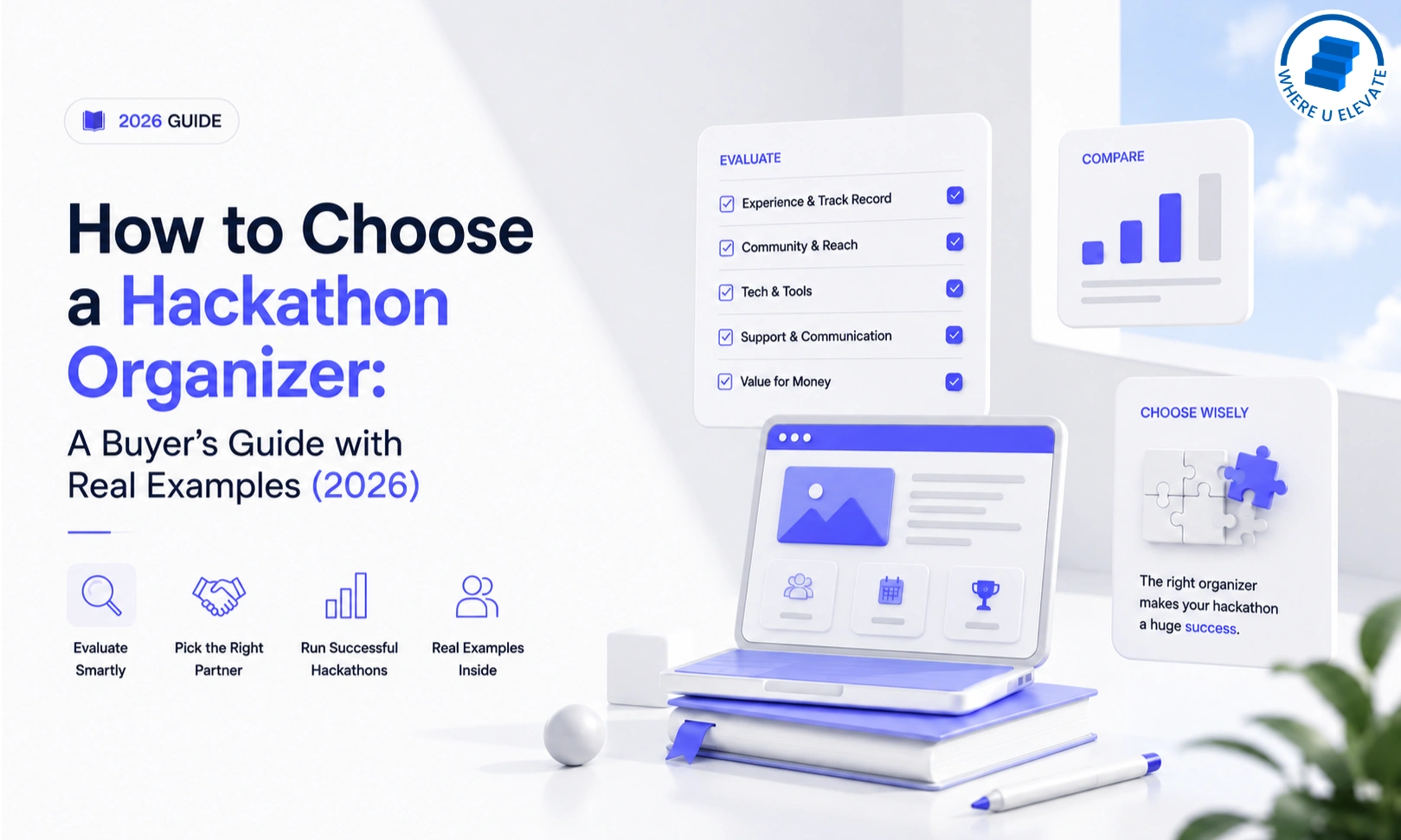
Avoid costly mistakes when choosing a hackathon organizer. Compare proven evaluation criteria, real examples, and the questions every buyer should ask.
Where U Elevate is an Intelligent Talent Layer Infrastructure platform that helps enterprises, academic institutions, and government bodies run hackathons that convert into real hiring and innovation outcomes - not just leaderboard events.
Quick answer: Judge a hackathon organizer on four things: whether they design for a defined business outcome (not just an event), whether they've handled scale and complexity comparable to yours, whether they can show real post-event conversion data, and whether they have verifiable case studies - not just a pitch deck.
→ Book a free demo with Where U Elevate
The Four Types of Hackathon Organizers
Before comparing specific zones, it helps to understand the category each one falls into - they're built for different jobs:
Software platforms provide the technology layer - registration, submission handling, judging tools - often with add-on services for sourcing and reporting. Best fit when you have internal event-management capacity and mainly need reliable infrastructure at scale.
Managed service organizers run the full event lifecycle end-to-end: problem design, sourcing, judging, logistics, reporting. Best fit when you don't have internal bandwidth to run the event yourself, or the event is complex enough (multi-city, multi-stakeholder) that dedicated execution expertise matters more than doing it in-house.
University and community partners specialize in campus-based or community-specific events, often with existing relationships inside a specific student or developer population. Best fit for recruiting-focused or education-first hackathons where access to a particular community matters more than enterprise-scale infrastructure.
Innovation consultancies treat the hackathon as one tool inside a broader innovation strategy engagement - often bundled with R&D advisory or open-innovation program design. Best fit for organizations that want strategic guidance on why and how to run innovation programs, not just execution.
Most organizers blend two of these categories, so it's worth asking directly which one best describes them before assuming.
Procurement Considerations Enterprises Often Overlook
A few practical factors matter more than most RFPs account for:
- Data privacy and compliance, especially for government or regulated-industry events where participant and submission data needs specific handling.
- Contractual scope creep - sourcing, judging, and post-event reporting are sometimes billed separately even when a proposal implies they're included.
- Internal bandwidth realism - a software platform is cheaper on paper than a managed service, but only if your own team genuinely has the time to run sourcing, judging, and logistics.
- Approval timelines - multi-stakeholder (government, multi-department enterprise) hackathons need longer procurement and sign-off cycles than a single-team student event; plan the vendor selection timeline accordingly.
Why the Organizer You Pick Actually Matters
Hiring through hackathons sits inside a much bigger shift: skills-based hiring. According to Deloitte research, organizations that adopt skills-based hiring see a 107% improvement in placing people into the right roles, and 98% higher retention of top performers compared to resume-first hiring. Separately, NACE's 2026 Job Outlook survey found 70% of employers now use skills-based hiring, up from 65% the year before.
Hackathons are one of the few hiring formats built entirely around demonstrated skill rather than a resume - which is exactly why the organizer's execution quality determines whether that promise is actually delivered, or just a marketing claim.
The Organizer Fit Framework
Once you know which category fits your goal, use these four criteria to evaluate any specific vendor within it - this applies whether you're looking at a platform, a managed service, or a consultancy:
1. Outcome Design - Does the organizer start by defining your business outcome (hires, prototypes, brand reach), or start with logistics and prizes? Outcome-first design is the clearest signal of a mature vendor.
2. Complexity Match - Has the organizer handled an engagement at a comparable scale and stakeholder complexity to yours - single-city vs. multi-city, single-team vs. multi-department, private-sector vs. government?
3. Data Transparency - Will they show you what a real post-event report contains before you sign, including conversion metrics (hires, prototypes advanced) rather than just attendance counts?
4. Verifiable Proof - Can they point you to a named, checkable case study with real outcomes, rather than aggregate claims like we've run 200 events?
A vendor that's strong on all four, regardless of category, is worth serious consideration. One that's vague on more than one is worth further scrutiny before signing.
What Good Actually Looks Like: Real Cases, Not Theory
Rather than a hypothetical scoring system, here's what a well-run hackathon program actually produces, drawn from real, named engagements:
Government-scale execution. Where U Elevate managed an international cybersecurity hackathon for the Cybersecurity Centre of Excellence (CCoE), DSCI, and the Government of Telangana - a 24-hour Capture the Flag event that drew over 10,000 registrations from 26 countries and all 29 Indian states, with 1,000+ live participants, and led to 10 cybersecurity professionals placed within a week of the event closing.
City-scale mobilization. For the Department of Education, Government of NCT Delhi, and VISV Foundation, the platform coordinated Delhi AI Grind - mobilizing over 500,000 AI innovators across 10 parallel tracks, managing 200+ jury members, and producing 1,000+ prototypes, culminating in a finale presided over by Delhi's Chief Minister.
Direct hiring conversion for a startup. For YoLearn.AI, a multi-track hiring hackathon on the platform's DRILL system closed 10 challenge-validated hires across 3 roles in 15 days - replacing what would typically be months of sequential recruiting.
Academic and cultural impact. In partnership with Rishihood University, the Tech4Heritage hackathon used AI to support restoration work related to the Ajanta and Ellora cave paintings - an example of hackathons applied to research and public-good problems, not just recruiting.
These are useful less as to look how good we are and more as a template for what to ask any organizer you're evaluating: can they name a comparably scaled, verifiable engagement with real numbers attached?
A Practical Framework for Evaluating Any Organizer
Instead of an arbitrary point system, use these four qualitative checkpoints - they map directly to what separates a real outcome from an event that just happened:
1. Outcome design, not just event logistics. Ask what business outcome the organizer designs around before the first problem statement is written. An organizer who starts with a venue and prizes, rather than your hiring or innovation goal, is optimizing for event day, not your results.
2. Complexity match. A vendor who only runs single-city, single-track student hackathons may struggle with a multi-track enterprise hiring challenge or a government-scale, multi-state event. Ask for a reference at a comparable scale to yours.
3. Verifiable post-event data. Ask exactly what a post-event report contains: registration counts are easy; conversion data (hires made, prototypes advanced, follow-on funding or adoption) is the real signal of a mature organizer.
4. Named, checkable case studies. Any organizer worth hiring should be able to point you to specific, named engagements with real client names and real numbers - not just we've done 200 hackathons.
Questions to Ask Before You Sign Anyone
- Can you name a client engagement at a similar scale to ours, with a named contact I can call?
- What does your post-event report include beyond attendance - hires, prototypes advanced, follow-on outcomes?
- Who owns sourcing mentors and judges - you, or do we have to bring our own network?
- What's your process for handing off hackathon winners into an actual hiring pipeline?
- What happens if participant numbers or engagement fall short mid-event - what's your contingency plan?
Who Should Use What Kind of Organizer
- Government and public-sector programs need an organizer with experience coordinating multi-stakeholder, multi-state logistics and jury management at scale - the Delhi AI Grind and CCoE Telangana engagements above are examples of that specific capability.
- Enterprises hiring for niche technical roles should prioritize an organizer with a documented hiring-conversion pipeline, not just event execution - the YoLearn.AI case is the relevant model here.
- Universities and research institutions should look for organizers experienced in academic partnerships and applied research problem statements, similar to the Tech4Heritage collaboration with Rishihood University.
What Organizations Actually Say
Real feedback matters more than a pitch deck. From participants and hiring partners who've worked with Where U Elevate directly: one enterprise hiring lead described the team's coordination between organizer and HR as consistently reliable throughout a recruitment cycle. A hackathon winner from a virtual coding challenge noted the event was well-run enough that it led directly to a job offer after the interview process. Another participant credited the team's attentiveness to understanding their career goals as the reason they landed a role that fit.
(Full testimonials and named sources are on the Where U Elevate solutions page.)
Common Mistakes When Choosing a Hackathon Organizer
- Judging by follower count or number of past events instead of scale-matched, checkable case studies
- Not asking what happens after the event - the hiring/incubation handoff is where most value is lost
- Assuming any organizer can handle government or multi-stakeholder complexity without asking for a directly comparable reference
- Treating the hackathon as a one-off instead of part of a repeatable talent pipeline
Frequently Asked Questions (FAQ)
1. Who organizes hackathons?
Hackathons are organized by companies, universities, government agencies, startups, nonprofits, and developer communities. Depending on the event's goals, organizations may manage the hackathon internally or work with a professional hackathon organizer or platform that handles planning, participant outreach, mentor and judge coordination, event operations, and post-event reporting.
2. How to host your own hackathon?
To host a successful hackathon, first define a clear objective, such as hiring talent, solving business challenges, or encouraging innovation. Then create problem statements, set the event format and timeline, recruit participants, mentors, and judges, choose the right technology platform, establish evaluation criteria, and plan follow-up activities such as hiring, incubation, or implementation of winning ideas.
3. Can we use ChatGPT in a hackathon?
Yes, many hackathons allow participants to use AI tools like ChatGPT for brainstorming, coding assistance, debugging, documentation, or research. However, the rules vary by event. Participants should review the organizer's guidelines, disclose AI usage if required, and ensure their final work complies with originality, licensing, and judging requirements.
4. How much does a hackathon cost?
Hackathon costs depend on factors such as event size, format, duration, prizes, technology platform, marketing, venue, and operational support. Small virtual hackathons can be organized with relatively modest budgets, while large in-person or enterprise hackathons typically require higher investment for logistics, participant experience, mentoring, judging, and post-event activities.
See Case Studies Before You Decide
Comments
No comments yet. Be the first to comment!