Why Enterprise Teams Can't Run Internal Hackathons Alone - And What Happens When They Try
8 min read
●
24 June 2026
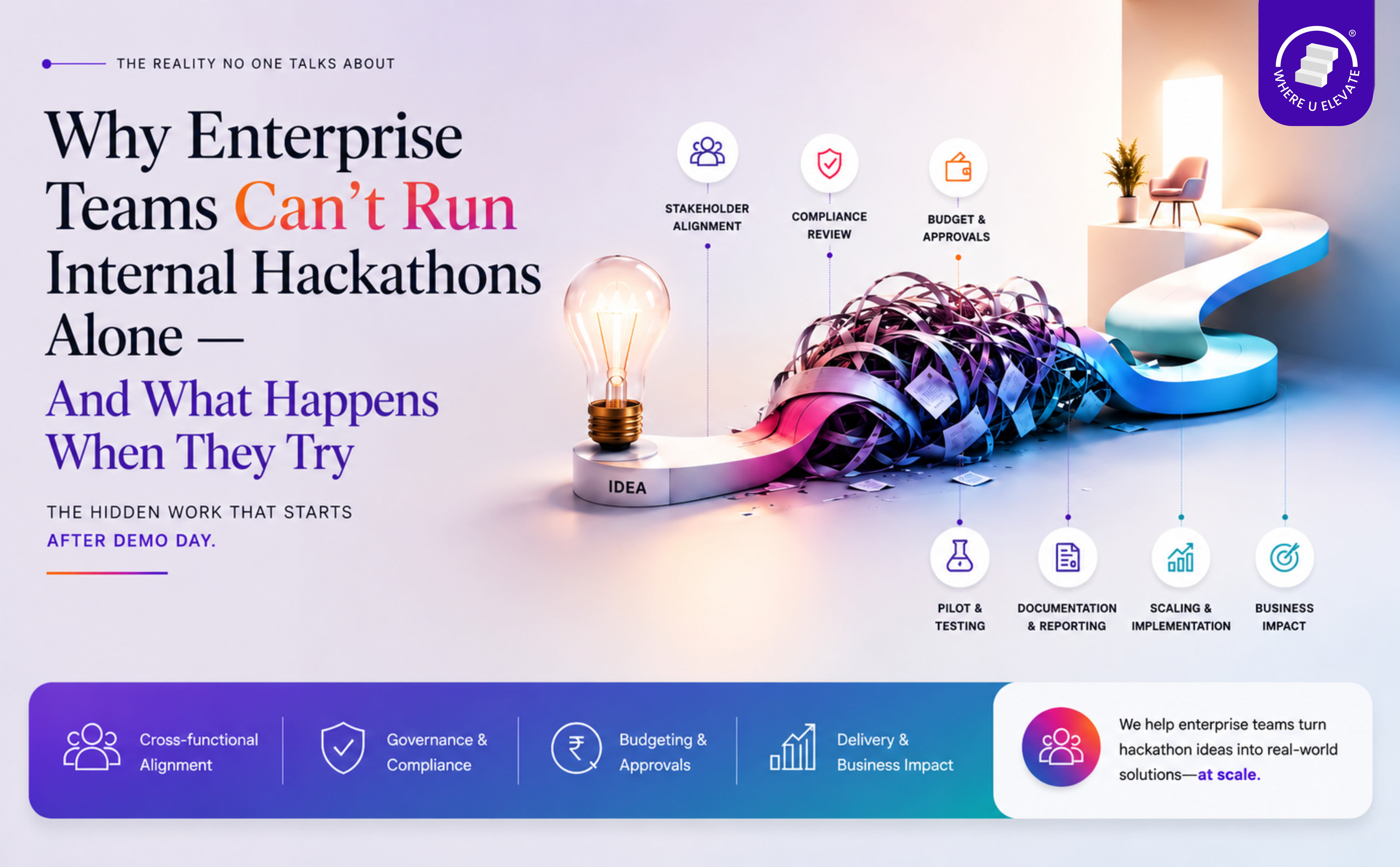
Most enterprise hackathons don't fail during the event - they fail in the weeks before and months after. Here's why enterprise teams struggle to run them alone.
What Is an Internal Hackathon for Employees?
An internal hackathon for employees is a structured enterprise innovation program where employees collaborate across departments to solve business challenges, develop new ideas, and create solutions that can be implemented inside the organization. Unlike public hackathons, internal programs focus on business outcomes, employee engagement, and innovation culture.
Every enterprise team starts from the same place: quiet, reasonable confidence.
You have project managers. You have Slack, Jira, Google Workspace. You have people who've run large events before. The budget looks manageable. Someone in the planning meeting says we'll handle it internally - and everyone nods.
For the first three weeks, they do.
Then 400 employees register instead of 120. Four departments each want custom problem statements. Legal raises IP ownership questions nobody anticipated. The project manager borrowed from the product gets pulled back two weeks before the event. Mentor conflicts start arriving faster than anyone can resolve them.
What was planned as a three-day innovation sprint has now consumed nine weeks of senior bandwidth - and the event hasn't started yet.
This is not one unlucky organization's story. This is the default outcome.
🚀 Stop rebuilding from scratch every cycle.
See How Where U Elevate Manages Enterprise Hackathons → Click Here
The Part Nobody Budgets For
Most organizations treat an internal hackathon for employees as a short-term event. In reality, successful programs operate like enterprise innovation programs that require governance, coordination, stakeholder management, and implementation oversight.
Here's what a single enterprise hackathon cycle actually requires:
Before the event:
- Strategic challenge design aligned to business priorities
- Participant eligibility frameworks and registration workflows
- Mentor sourcing, vetting, and briefing across 40–80 subject-matter experts
- Legal review of IP ownership frameworks
- Communication architecture segmented across participants, mentors, judges, and executives
During the event:
- Real-time participant support across hundreds of teams
- Mentor session tracking and live conflict resolution
- Submission management across 80–200 competing teams
- Multi-stage judging coordination with scoring standardization
After the event - where most programs die:
- Idea handoff protocols to named implementation owners
- Progress tracking for winning projects across quarters
- ROI documentation for executive reporting
- Cycle two planning informed by cycle one data
Now ask honestly: which of these does Jira handle? Which does Slack handle? Which does a borrowed project manager - managing this alongside their actual job - have the bandwidth to execute while the event is live?
The answer exposes the illusion immediately.
📋 Your team's time is too valuable for logistics.
Book a 30-Min Strategy Session with Where U Elevate
The Real Cost Is Invisible on the Budget Sheet
Running a 300-participant enterprise hackathon internally typically consumes 400–700 hours of senior employee time across the full program cycle. Not junior coordination hours. Hours pulled from innovation heads, HR business partners, L&D leads, and department managers.
When those hours are honestly accounted for against the cost of purpose-built infrastructure, the economics of internal management collapse almost every time.
But the human cost is only the first layer. There are two more:
The quality cost. Internal teams make the same operationally predictable mistakes - evaluation criteria that feel inconsistent, mentor briefings that arrive too late, submission processes that create confusion on day two. These aren't intelligence failures. They experience failures. A corporate hackathon organizer with 50 programs behind them has already built systems to prevent what your team hasn't encountered yet.
The opportunity cost - the most expensive and most ignored. The ideas that never reached implementation because the post-event handoff was unstructured. The high performers who disengaged when coordination felt chaotic. The executive sponsor who quietly decided not to fund cycle two because the ROI report was thin and unconvincing.
None of this appears in a debrief. All of it compounds.
The Threshold Where Difficult Becomes Impossible
There is a specific scale at which internal hackathon management crosses from painful to structurally unsustainable.
For most enterprise organizations, that threshold is 150–250 participants.
Below it, a disciplined internal team can manage. It will cost more than planned. It will exhaust people. But it can be done.
Above it - and certainly at the 500 or 1,000+ participant level that enterprise-wide programs require - the complexity scales in a way that effort alone cannot address:
- Mentor-participant touchpoints multiply non-linearly
- Cross-team communication threads exceed any individual's tracking capacity
- Evaluation governance, without structured tooling, becomes subjectively inconsistent
- Post-event implementation tracking collapses entirely
This is not a project management problem a smarter spreadsheet solves. It is a structural problem that requires structural infrastructure.
The organizations scaling to 500 and 1,000 participants don't find better internal coordinators. They stop trying to manage it internally.
📈 Built for enterprise scale, not spreadsheet scale.
Explore Where U Elevate enterprise hackathon management Platform → Click here
The Lifecycle of Every Program That Never Makes the Shift
Year one: High energy, strong participation. Leadership celebrates. The internal team is exhausted but proud.
Year two: Ambition to scale. The same infrastructure applied to a bigger program. Execution quality drops in ways that are difficult to articulate but immediately felt - coordination delays, mentor unavailability, evaluation inconsistency, implementation collapse. Leadership notices.
Year three: The internal champion gets promoted, transferred, or burned out. Institutional knowledge walks out with them. The program is paused for restructuring - which is organizational language for a quiet death.
The painful irony: the programs that succeed in year one create the very scale that destroys them in year two.
And the employees who participated, saw their ideas go nowhere, and drew conclusions about whether the organization is serious about innovation - they don't forget.
What India's Enterprise Workforce Is Actually Telling You
Employee engagement hackathon programs in India carry higher stakes than most leadership teams realize.
India's enterprise workforce is young, digitally native, and acutely sensitive to the difference between genuine organizational investment and performative innovation theater. When coordination is chaotic, participants notice immediately. When mentors are unprepared, high-performing teams disengage. When winning ideas disappear into post-event silence, employees draw one conclusion:
This organization doesn't actually intend to do anything with our ideas.
That conclusion spreads through the workforce in ways leadership never hears - and shapes participation decisions for every future program.
A poorly executed hackathon doesn't just fail to deliver innovation outcomes. It actively destroys the employee trust it was designed to build.
You cannot send the right signal with a borrowed project manager and a Google Form.
The Three Commitments That Separate Programs That Scale From Programs That Die
Organizations running multi-year, executive-funded innovation programs made three decisions early — before their programs broke them publicly:
1. Purpose-built infrastructure over repurposed tools.
A dedicated innovation hackathon platform that manages the complete lifecycle — registration, team formation, mentor coordination, evaluation governance, implementation tracking, and ROI analytics — in one visible system. Not 14 disconnected spreadsheets with gaps between them.
2. External execution expertise over internal trial and error.
A corporate hackathon organizer brings the accumulated knowledge of 50+ programs — every execution problem your team hasn't encountered yet, and the systems built to prevent them. That knowledge, applied from program one, compresses three years of painful organizational learning into a single successful cycle.
3. Governance before the first registration opens.
IP ownership frameworks. Evaluation criteria with defined business relevance weighting. Funding pathways for winning ideas. Named implementation owners with timelines. Every element organizations typically improvise under event-day pressure — defined in advance.
These three commitments are not expensive. The alternative - rebuilding broken infrastructure after a public execution failure - is far more expensive in budget, credibility, and momentum.
The Question That Reframes Everything
At some point, every enterprise hackathon planning conversation comes down to one question:
Can't our team just handle this?
Your team is capable. That is not the issue.
The issue is whether managing hackathon logistics - registration, mentor coordination, submission processing, evaluation governance, implementation tracking, ROI documentation - is the highest-value use of their capability.
Or whether their time would generate more value focused on what requires their specific knowledge: challenge design aligned to business strategy, executive relationship management, cross-functional participation, and idea implementation advocacy.
The organizations building the best innovation programs are the ones most honest about this distinction.
FAQ
1. What to Do in an Internal Hackathon?
An internal hackathon is a workplace innovation event where employees collaborate to solve business challenges, improve processes, or develop new ideas. Participants typically form teams, work on solutions, create prototypes, and present their ideas to judges. Internal hackathons help organizations encourage innovation, collaboration, and employee engagement.
2. What Is an HR Hackathon?
An HR hackathon is a structured event where participants develop solutions for human resources challenges such as recruitment, employee engagement, learning, or workplace culture. HR teams, employees, and students collaborate to generate ideas, build prototypes, and address workforce-related problems through innovation and teamwork.
3. Can I Get a Job Through a Hackathon?
Yes, you can get a job through a hackathon if you demonstrate strong problem-solving, teamwork, and technical skills. Many companies use hackathons to identify talent and evaluate candidates in real-world scenarios. High-performing participants often gain networking opportunities, interviews, internships, or full-time job offers.
4. What Is a Hackathon at Work?
A hackathon at work is an organized innovation event where employees collaborate to solve business problems, develop new products, or improve existing processes within a limited timeframe. Workplace hackathons encourage creativity, cross-functional teamwork, employee engagement, and the generation of ideas that can support business growth.
Conclusion
Where U Elevate helps enterprises transform an internal hackathon for employees into a repeatable enterprise innovation program. Through structured hackathon program management, implementation tracking, participant engagement, and innovation governance, organizations can scale innovation without overwhelming internal teams.
Start the Conversation with Where U Elevate → https://whereuelevate.com/organization
Comments
No comments yet. Be the first to comment!