What Is an Ideathon? Complete Guide with Judging Criteria, Examples & Expert Tips (2026)
6 min read
●
Updated 31 July 2026
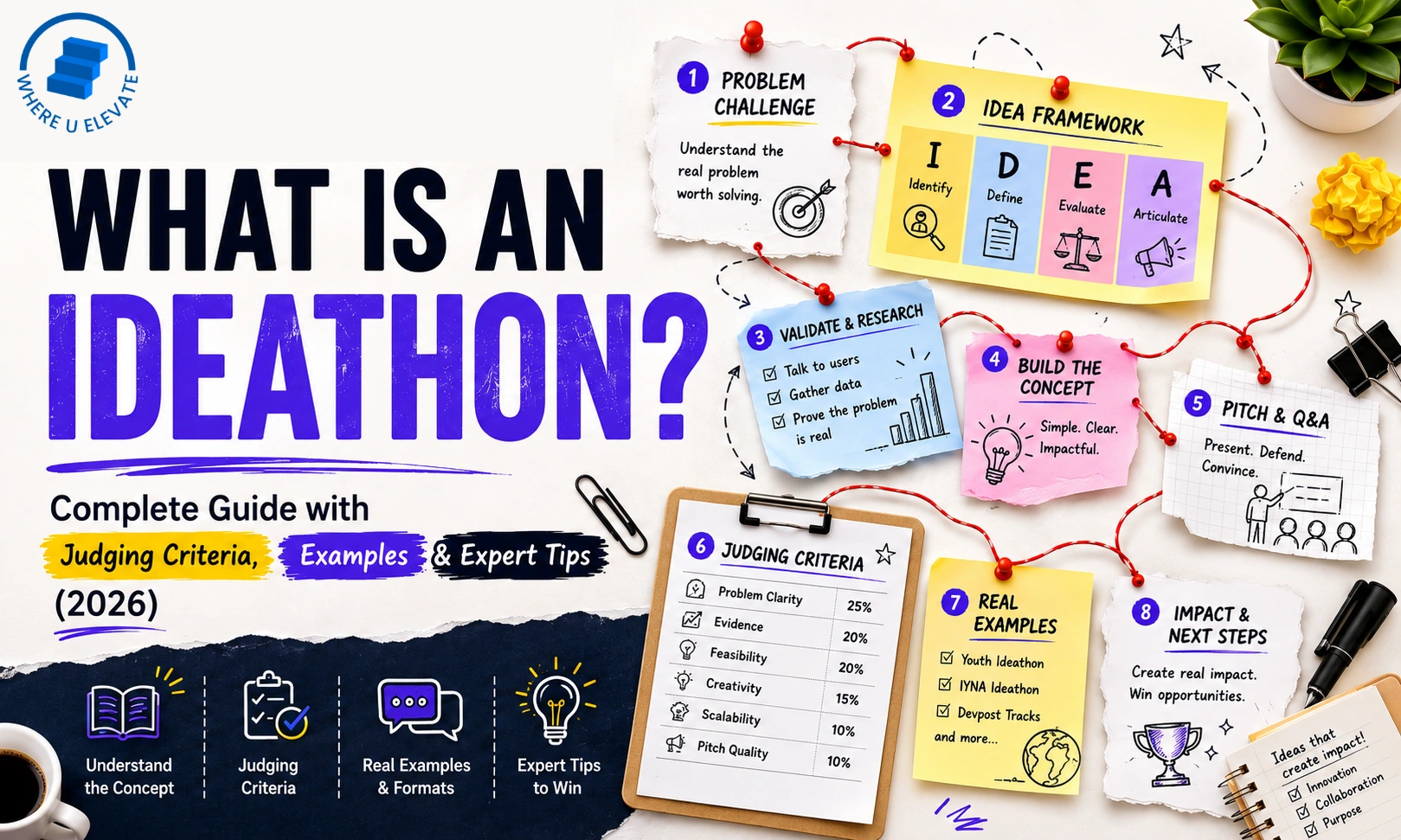
What is an ideathon? Learn how it works, judging criteria, real examples, and expert tips to turn ideas into winning solutions in 2026.
An ideathon is easier to understand by watching one happen than by reading a definition of it. Teams get a problem, a few hours, and no code - just a concept and a pitch. What separates the teams that place from the teams that don't isn't usually the idea itself. It's whether they can defend it. This guide covers what an ideathon actually is, an original framework we built for approaching one, real examples with sources, and the mistakes that sink otherwise good ideas.
Short Answer
An ideathon is a time-boxed competition where teams develop and pitch a concept - not a working prototype - to solve a defined problem. No coding required. Judged on the strength of the thinking and the pitch, not the build. Usually runs a few hours to a full day.
The IDEA Framework
This is our own synthesis, built for this guide - Identify, Define, Evaluate, Articulate - not a claim that every ideathon judges against these exact four steps. It's a practical way to structure your prep time.
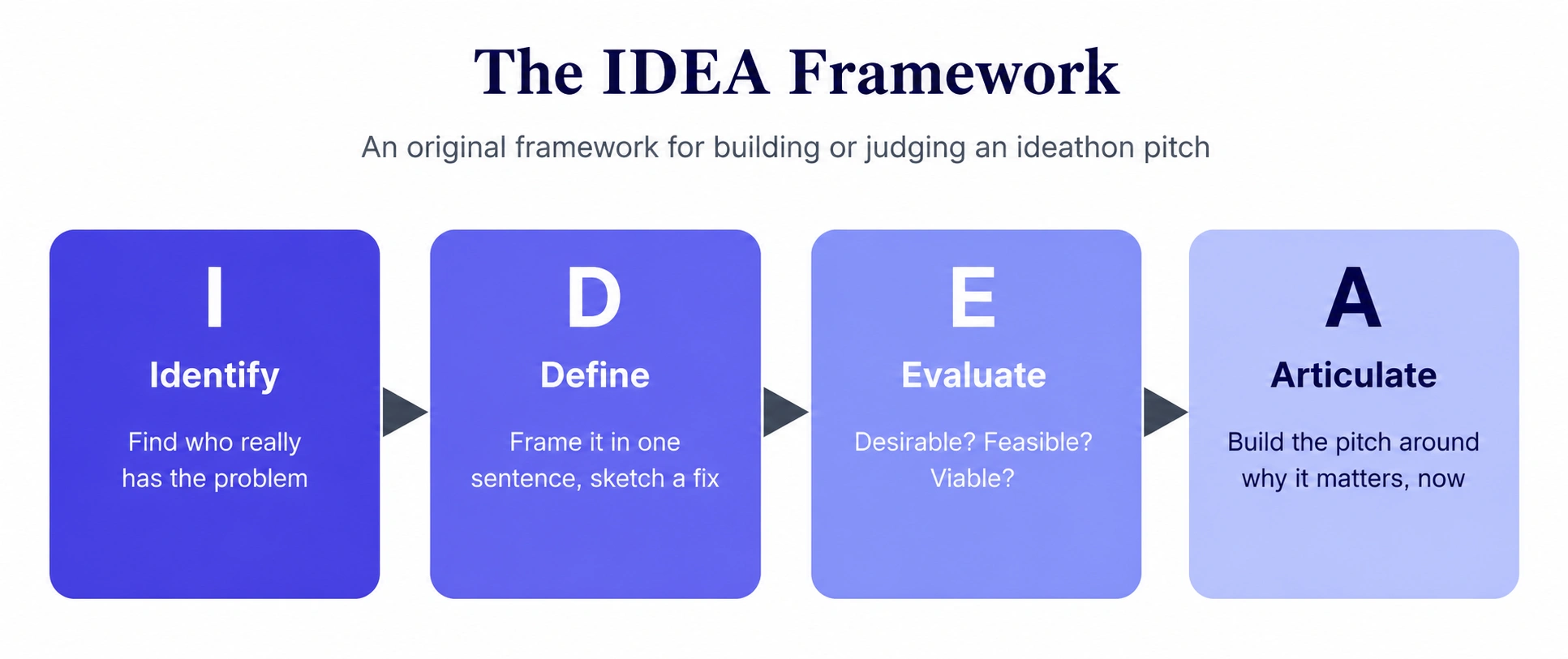
Identify - find who really has the problem, not who you assume has it. Closer to customer discovery than brainstorming: think concretely about the person affected before generating a single solution.
Define - frame the problem in one sentence, and sketch the shape of a solution using something like a Lean Canvas or a simple problem-solution-audience outline. Source: Lean Canvas, LeanStack — Ash Maurya's one-page framework for early-stage ideas.
Evaluate - run the idea against the desirability, feasibility, and viability lens associated with human-centered design work: is it desirable (do people actually want it), feasible (can it realistically be built), and viable (does it hold up economically or logistically)? This three-part lens isn't something we invented - we're applying a well-established design framework to ideathon prep specifically. Source: IDEO, Design Thinking and the Stanford d.school.
Articulate - build the pitch around why it matters and why now, not a feature list.
An Illustrative Judging Rubric
We want to be direct about what this is: a synthesis based on patterns visible across several publicly available ideathon judging criteria, not a universal standard or any single event's actual rubric. Treat it as a reasonable starting point for prep - check the specific event's published rubric when one is available.
Criteria | Illustrative Weight | What It's Actually Checking |
| Problem clarity | 25% | Can the problem be stated in one sentence? |
| Evidence | 20% | Is there any real basis for the problem being real? |
| Feasibility | 20% | Could this plausibly get built, given real constraints? |
| Creativity | 15% | Does it go beyond the obvious first answer? |
| Scalability | 10% | Does it work past the first 10 users? |
| Pitch quality | 10% | Can the team defend it live, under questioning? |
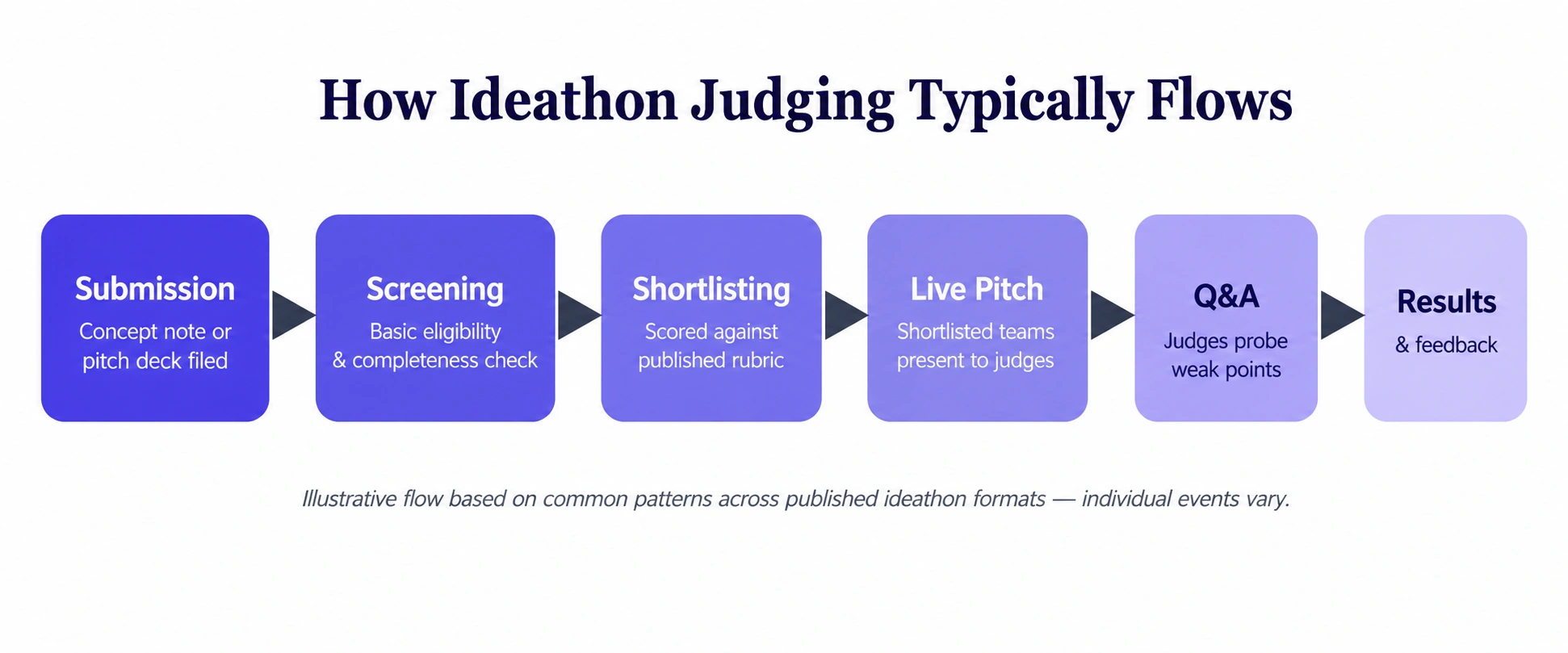
A Day Inside an Ideathon
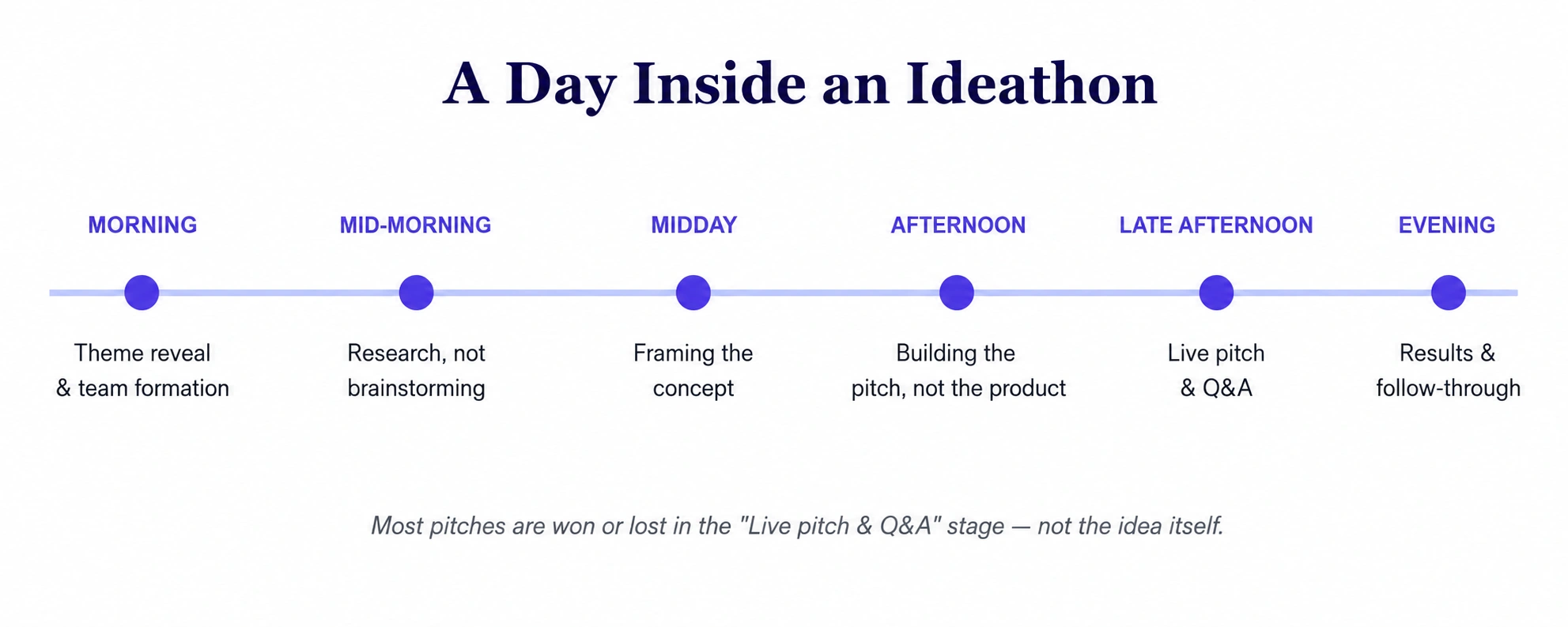
Most single-day formats move through theme reveal, team formation, and research in the morning, framing and pitch-building through the day, and a live pitch-and-Q&A session in the late afternoon - which is where most ideathons are actually decided, not in the idea itself.
Five Reasons Teams Lose
The following is editorial guidance, not a scored study - it reflects patterns visible across the judging criteria and formats we reviewed while researching this guide, not a claim about any specific event's outcomes:
- Jumping to a solution before validating the problem. A team that spends real time proving the problem is real tends to out-argue a team with a flashier fix and no evidence behind it.
- No user validation, even informal. We think people want this as a guess. We asked five people who deal with this weekly as evidence, even at a small scale.
- An idea that isn't actually feasible. Reviewers weighing feasibility at 20% (per the illustrative rubric above) will generally down-score an idea with no plausible path to existing, however ambitious.
- A weak pitch defending a decent idea. Teams that don't rehearse the Q&A tend to get caught on questions they should have anticipated.
- No evidence anywhere in the pitch. Claims without numbers or research read as guesses, even when the underlying instinct is sound.
Real Examples, With Sources and Takeaways
Youth Ideathon Source: youthideathon.in India's CBSE-aligned school and college innovation competition, run by ThinkStartup with MEPSC. Its most recent edition reported participation across thousands of schools, per the event's own published figures. What to learn from it: Its structure rewards ideas that work within real infrastructure constraints - submissions assuming resources most schools don't have tend to underperform. Best suited to students newer to competitive formats, given its structured, school-integrated approach.
IYNA Ideathon Source: youthneuro.org/ideathon A fully virtual neuroscience-focused competition for high school and undergraduate students, run by the International Youth Neuroscience Association, with a themed proposal-and-pitch structure each cycle. What to learn from it: Running fully virtual removes the lab-access barrier that would otherwise gatekeep a niche academic topic. Best suited to students with genuine subject-matter interest rather than general competition-seekers, since the theme is narrow and research-driven.
Devpost's Ideathon Tracks Source: ideathone-2026.devpost.com Several innovation challenges on Devpost now run dedicated concept-only tracks alongside build tracks, aimed at participants who want to compete without coding. What to learn from it: Separating concept-only from build tracks addresses a real fairness gap — in mixed-format events without this separation, non-coders often compete against teams shipping working software. Best suited to students who want the Devpost ecosystem's scale without needing technical execution.
Ideathon, Hackathon, Datathon, Case Competition, or Startup Competition?
Deliverable | Technical skill needed | Typical length | |
| Ideathon | Concept / pitch | None | Hours to 1 day |
| Hackathon | Working prototype | High | 24–48+ hours |
| Datathon | Data model / analysis | Moderate-high | 24–48 hours |
| Case competition | Business recommendation | None | 1 day to 1 week |
| Startup competition | Pitch + early traction/MVP | Low-moderate | Weeks to months |
If you have an idea but nothing built yet, an ideathon is the right entry point. If you already have a working MVP and early traction, a startup competition or incubation program is a better fit than an ideathon.
Before You Launch One: An Organizer's Checklist
- Has the problem statement been tested on people outside the organizing team, so it's neither too narrow nor too vague?
- Are mentors confirmed, and briefed that they're most useful during the framing stage, not just at judging?
- Is the judging rubric published in advance, so teams know what they're being scored on?
- Is there a follow-up pathway - mentorship, incubation, or structured feedback - for teams after the event ends?
- Is there an industry or institutional sponsor who can carry a good idea past the trophy?
We'd frame the last two points as informed judgment rather than proven pattern: it seems reasonable that ideathons without any follow-up pathway see softer participation in future editions, since students talk to each other about which competitions were worth the weekend - but we don't have data confirming that specific effect.
Frequently Asked Questions (FAQs)
1. What is Ideathon meaning?
An ideathon is a time-bound innovation competition where individuals or teams develop, refine, and present ideas to solve a specific problem. Unlike a hackathon, participants typically focus on research, creativity, and pitching a solution rather than building a working prototype.
Most ideathons last from a few hours to one day and conclude with teams presenting their ideas to a panel of judges. Evaluation commonly considers factors such as problem understanding, originality, feasibility, evidence supporting the idea, and presentation quality. The exact format and judging criteria vary by organizer.
2. What is the difference between a hackathon and an ideathon?
The main difference is the expected outcome.
Ideathon | Hackathon |
| Teams develop and pitch an idea. | Teams build a working prototype or product. |
| Coding is usually not required. | Coding or technical implementation is usually expected. |
| Focuses on problem identification, creativity, and feasibility. | Focuses on execution, technical skills, and product development. |
| Typical duration: a few hours to one day. | Typical duration: 24–48 hours or longer. |
An ideathon is often the right choice for participants who have a strong concept but are not yet ready to build it, while a hackathon is designed for turning ideas into functional prototypes.
3. Who is eligible for Cisco Ideathon 2027?
Eligibility for Cisco Ideathon 2027 depends on the official rules published by Cisco or the organizing partner for that edition. Requirements can change each year.
In previous editions, eligibility has commonly included:
- Students enrolled in eligible colleges or universities.
- Specific academic years or graduation batches.
- Individual or team participation, depending on the event format.
- Compliance with registration deadlines and competition rules.
Always refer to the official Cisco Ideathon 2027 announcement or rulebook for the latest eligibility criteria, as they may differ from previous editions.
4. What is Ideathon 2026?
Ideathon 2026 is a general term used to describe ideathon events taking place during 2026 rather than one specific competition. Universities, companies, startups, government organizations, and non-profits organize ideathons throughout the year to encourage participants to develop innovative solutions to real-world challenges.
While each event has its own format, most Ideathon 2026 competitions involve:
- A problem statement or theme.
- Team-based idea generation.
- Research and solution development.
- A pitch presentation.
- Judging based on criteria such as innovation, feasibility, impact, and presentation.
Participants should review the official guidelines of the specific Ideathon 2026 event they plan to enter, as rules, timelines, prizes, and judging criteria vary by organizer.
Related Reading
- Lean Canvas — Ash Maurya's framework for structuring an early-stage idea
- Business Model Canvas — Alexander Osterwalder's broader strategy framework
- Design Thinking at IDEO and the Stanford d.school
Explore Ideathons and Innovation Challenges
If you're looking for ideathons and innovation competitions to join, Where U Elevate helps students across India discover and register for relevant opportunities.
[Explore Where U Elevate ]
Comments
No comments yet. Be the first to comment!