Smart India Hackathon 2026: Registration, Eligibility & Internal Hackathon Rules Most People Skip
12 min read
●
Updated 21 July 2026
Smart India Hackathon 2026: Registration, eligibility, and the internal hackathon rules most teams miss before submission. Don't apply until you've read this guide.
Most Smart India Hackathon 2026 guides repeat the same eligibility list and call it a day. This one focuses on the part that actually decides whether your team reaches the Grand Finale: the internal hackathon at your own college - the stage where most teams are eliminated before the national portal even sees their idea.
What is Smart India Hackathon 2026?
Smart India Hackathon (SIH) is India's flagship nationwide innovation competition, run by the Ministry of Education's Innovation Cell (MIC) and AICTE, with participating government ministries, PSUs, and industry partners. Teams solve real problem statements submitted by these organizations - not hypothetical case studies - across sectors like governance, healthcare, education, agriculture, cybersecurity, sustainability, transportation, and finance.
Quick facts — Smart India Hackathon 2026:
| Organized by | Ministry of Education's Innovation Cell (MIC) + AICTE |
| Started | 2017 (Software only); Hardware edition added 2018 |
| Editions | Software Edition (36-hour non-stop) and Hardware Edition (multi-day build) |
| Team size | 6 students + 1–2 mentors, minimum 1 female member mandatory |
| Prize per problem statement | Prize amounts are announced for each edition. Please verify the latest prize structure on the official SIH portal. |
| Themes | Themes vary every edition depending on published problem statements. - AI/Automation, MedTech/BioTech/HealthTech, Agriculture & FoodTech, Smart Vehicles, Transportation & Logistics, Robotics & Drones, Clean/Green Tech, Renewable Energy, Blockchain & Cybersecurity, Heritage & Culture, Fitness & Sports, Disaster Management, Smart Education, and tertiary sector (finance, retail, hospitality) |
| SIH 2026 registration deadline | To be announced. Students should check the official SIH portal or their institution's SPOC for the latest registration timeline. |
| SIH 2026 problem statement count | Official problem statements are published on the SIH portal before the registration process. The total number varies each edition as new challenges are submitted by government ministries, public sector organizations, and industry partners. |
Why this matters beyond the competition itself: participants work on real industry/government problems, get mentored by domain experts, build an industry-ready portfolio, and often turn projects into internships, research work, or startups.
SIH 2026 Eligibility Criteria: Who Can Register?
Students enrolled in recognized higher education institutions - engineering, management, pharmacy, architecture, design, and other AICTE-approved or recognized programs. Exact eligibility (year of study, discipline restrictions) is confirmed per edition - check your institution's SPOC notice before assuming you qualify.
Core eligibility rules:
- Must be an active student at a recognized institution during the edition you're applying for
- Participation is through your institution, not individually
- Teams only - no solo entries
- Each team selects one officially published problem statement
- All members must be from the same college - inter-college teams are not permitted
- Minimum one female team member is mandatory
SIH Selection Process: From Internal Hackathon to Grand Finale
This is the part most guides gloss over, and it's the part that eliminates the most teams.
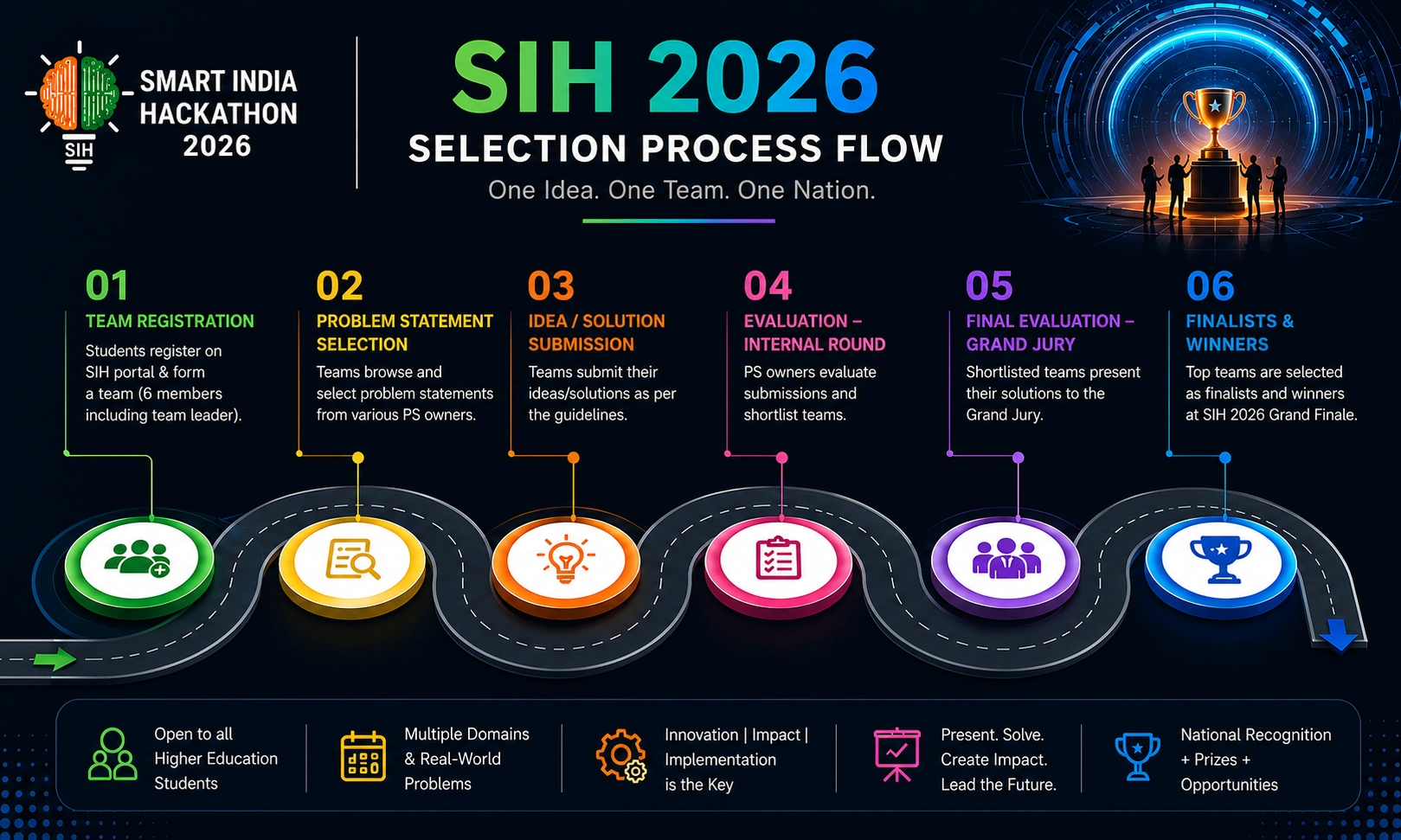
- Problem statements published — ministries, PSUs, and industry partners submit real challenges to the SIH portal.
- College SPOC registers and blocks problem statements — your Single Point of Contact (a faculty member) registers the institution and selects which PSs your college will work on.
- Internal hackathon (mandatory) — every participating college must run its own internal selection round. This is where most teams get filtered out, long before the national portal sees anything.
- SPOC nominates the strongest teams — the nominated count has varied across editions; confirm the current-year quota with your SPOC rather than assuming a fixed number.
- Idea submission on SIH portal — nominated teams submit their proposed solution for national-level review.
- Shortlisting — reviewers evaluate problem understanding, innovation, feasibility, and completeness of submission. Incomplete documentation can eliminate a strong idea.
- Grand Finale — shortlisted teams build, refine, and present at a nodal centre, under mentor guidance, in front of expert judges.
The practical takeaway: treat your internal hackathon with the same seriousness as the national finale. A polished presentation with a realistic implementation plan consistently outperforms an ambitious idea with no execution clarity - at both stages.
Didn't clear your college's internal hackathon — or worried you won't? hackFront India is a 20-week nationwide innovation league with open registrations. No SPOC nomination, no internal selection round, no gatekeeping. Register for hackFront India →
Software Edition vs. Hardware Edition
Software Edition | Hardware Edition | |
| Duration | 36-hour non-stop build | Multi-day (typically ~5 days) [VERIFY] |
| Focus | Web/mobile apps, AI/ML, data analytics, cybersecurity, cloud, blockchain, IoT software, automation platforms | Embedded systems, robotics, IoT devices, smart agriculture, healthcare devices, industrial automation, smart city tech |
| What you demonstrate | A functional software prototype | A physical prototype + supporting software |
Choose based on your team's actual expertise, not on which sounds more impressive to judges - feasibility is scored explicitly (see judging criteria below).
Choosing the Right SIH Problem Statement (With a Worked Example)
Before locking a problem statement, your team should be able to answer:
- Does our team genuinely understand this domain?
- Can we build a working prototype in the available time?
- Is there enough credible research/data to support our approach?
- Does this align with our actual technical strengths (not just what's trending)?
- Can we clearly explain the real-world impact to judges in under a minute?
Judges evaluate how effectively you solve the stated problem - not how many buzzword technologies you cram in. A well-scoped, deeply understood problem consistently beats an ambitious one your team can't fully execute.
A worked example of how to evaluate a problem statement:
Say a published problem statement asks for a system to help small farmers detect crop disease early using low-cost tools. Here's how a team would actually stress-test it before locking it in:
- Domain understanding check — Can your team name three real reasons current disease-detection methods fail farmers today (cost, internet access, expertise gap)? If not, you don't understand the problem yet — research first.
- Feasibility check — Do you have a team member who can build or fine-tune an image classification model in the build window, and does your team have any way to source or simulate leaf-image data? If the answer to either is no, this problem statement is a risk regardless of how exciting it sounds.
- Evidence check — Can you point to at least one government report, agricultural extension study, or dataset that supports your assumptions about farmer behavior and access? "We assumed farmers have smartphones" is not evidence; a cited adoption statistic is.
- Differentiation check — What existing apps or government schemes already attempt this, and what specifically will yours do differently — offline detection, lower cost, regional language support? If you can't name the gap, judges won't see one either.
- Impact check — Can you state, in one sentence, how many farmers this could realistically reach and what it saves them (time, crop loss, cost)? If the answer is vague, tighten the scope before you pitch it.
Running every shortlisted problem statement through this same five-question filter - before any code is written - is what separates teams that pick an idea they can defend from teams that pick an idea they merely like.
Smart India Hackathon 2026: Judging Criteria Explained
Criterion | What it means in practice |
| Problem understanding | Can you explain why this problem exists, who it affects, and why current solutions fall short — before you touch the tech stack? |
| Innovation | Not "newest technology used" — original thinking and a genuinely better approach, even with simple tools |
| Technical feasibility | Architecture, tech choices, scalability, security, and whether it could realistically deploy in the real environment |
| Impact | Who benefits, how many people, does it cut cost/time, is it socially useful, can it scale beyond one organization |
| User experience | Is it simple and accessible for the actual intended user — not just functional for a developer |
| Demonstration | A live, working demo of the core functionality beats a slide-heavy pitch every time |
Questions judges commonly ask (prepare concise, evidence-based answers):
- Why this problem statement specifically?
- What existing solutions did you evaluate, and how is yours different?
- What assumptions did you make?
- Can this scale nationally?
- What would you improve with more time?
- How would this be maintained post-deployment?
Building a Strong Smart India Hackathon Team
Winning teams combine complementary strengths, not five people with identical skills.
Role | Responsibility |
| Team Leader | Coordination, deadlines, communication |
| Developer(s) | Backend / frontend build |
| UI/UX Designer | Interface and user experience |
| Research Lead | Problem validation, competitive analysis |
| Documentation Lead | Reports, submissions, presentation materials |
| Domain Expert | Industry/subject-matter grounding, functional testing |
Assign clear ownership early - overlapping, undefined responsibilities cost teams time during the Grand Finale's compressed build window.
Preparation Playbook
Start with an MVP, not a feature list. Judges consistently favor a stable, working prototype over an ambitious build with incomplete functionality. Your MVP should solve the core problem, include only essential features, and hold up under a live demo.
Research before you write code. Answer: How is this solved today? What are the limitations? What do users actually need? Back assumptions with credible sources - government data, industry reports, published research - rather than guesses.
Design for the real user, not for the judge. Simple, intuitive, low-friction interfaces read as more credible than visual complexity.
On AI tools: useful for brainstorming, documentation, sample code, and debugging - but your team must be able to explain and defend every part of your submission. Judges will ask; "the AI generated it" is not an answer that survives a Q&A round.
Delivering the Presentation
- Problem — who's affected, why it matters, what's broken today (keep this brief)
- Solution — what it does, how it solves the problem, what's different about your approach
- Live demo — the most persuasive part of any pitch; prioritize this over slides
- Technology — architecture, stack, security, scalability - only after the demo, and kept concise
- Impact & close — benefits, target users, scalability, what's next
In Q&A: listen fully before answering, be direct, and if you don't know something - say so rather than guessing. Judges weigh honest uncertainty better than confident wrong answers.
Common Reasons Teams Don't Advance
- Weak grasp of the actual problem (jumping straight to tech)
- Overengineered solutions that outpace what the team can execute
- Incomplete or unstable prototypes at demo time
- Presentations that bury the product under architecture slides
- No measurable impact story
- Can't answer basic judge questions about their own assumptions
If any of this sounds like what happened to your team last edition, you're not out of options. hackFront India is a 20-week national innovation league with open registrations - no SPOC, no internal selection round, no gatekeeping. Teams work through a structured 6-week cohort with mentors before ever locking in a build, so you get the runway Smart India Hackathon's 36-hour format doesn't allow. See how hackFront India works → https://www.hackfrontindia.tech/themes
Didn’t Clear Smart India Hackathon 2026? What to Do Next
Eliminated at your college's internal hackathon? You are not out. hackFront India is a 20-week nationwide innovation league with open registrations - no SPOC, no internal selection, no gatekeeping.
hackFront India is the industry-driven parallel to SIH, run by Where U Elevate. It's built for students who want a longer runway than a single 36-hour sprint, and for teams who didn't make the SIH internal-hackathon cut but still want a shot at a national stage.
What makes hackFront India structurally different from SIH:
- 20-week distributed league, not a single weekend event — spanning 8 innovation themes across 2 sectors
- Campus Roadshows — 25+ campus days across 5 talent hubs to onboard students directly, rather than relying solely on a college SPOC to nominate
- Structured 6-week cohorts — teams work the problem space with mentors before ever submitting an idea, rather than jumping straight into a 36-hour build
- Ideathon → Prototyping → Grand Finale pipeline — teams submit a working prototype + problem brief (Ideathon), refine it across prototyping sprints with mentor reviews, and the Top 200 teams nationally are invited to a 36-hour build at the National Finale in Delhi, where 30 finalists pitch to industry juries
- Real industry briefs set by partner organizations, with pilot deployment opportunities post-finale — not just a certificate and a demo
- Incubation access — top teams get placed into partner incubators and corporate innovation labs to continue building after the event
- Rewards include cash + compute credits across clusters, plus deployment runway with the partner organization for overall winners
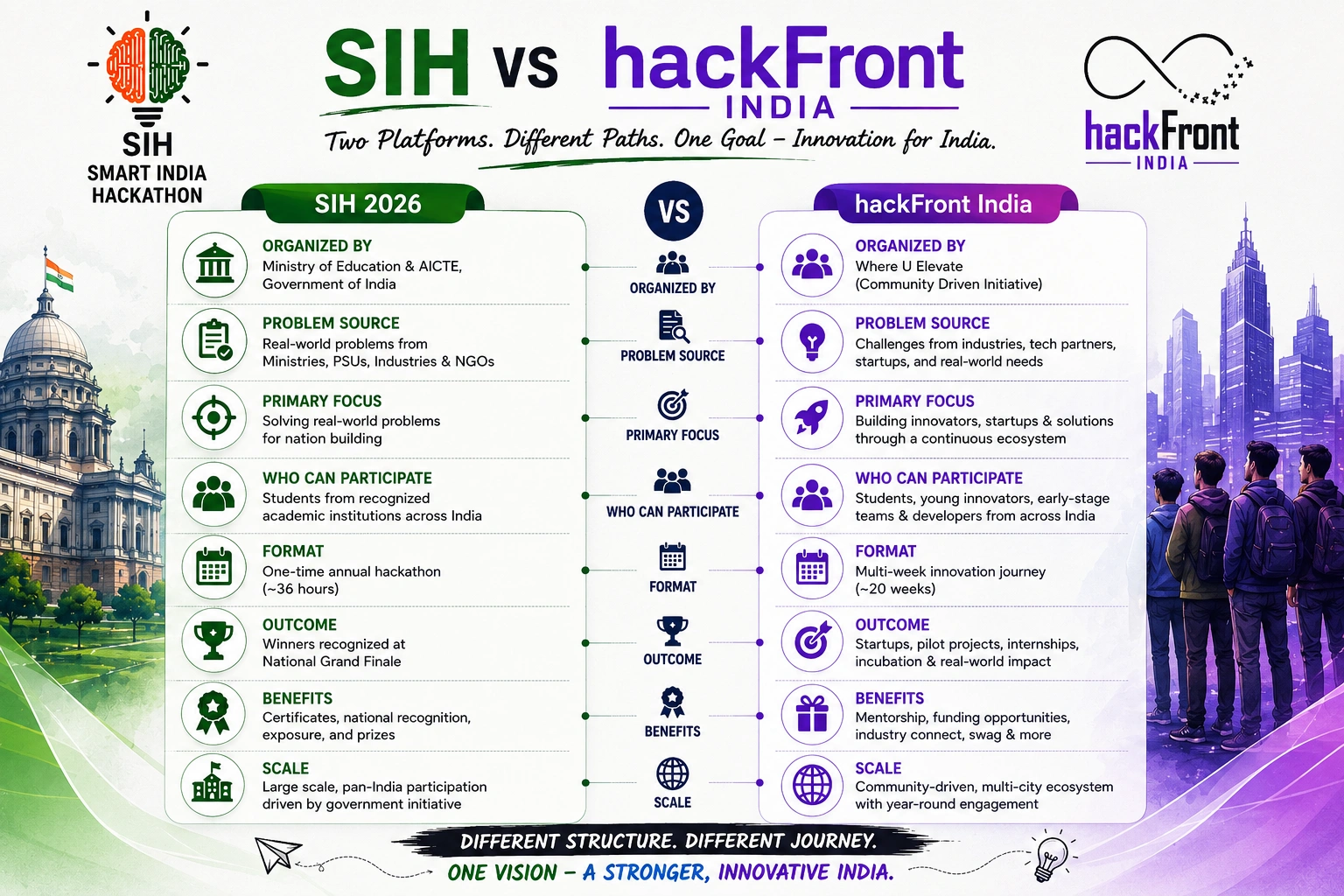
Smart India Hackathon 2026 vs hackFront India - Which Innovation Competition Is Right For You?
SIH | hackFront India | |
| Run by | Ministry of Education (MIC) + AICTE | Where U Elevate |
| Format | Single national event (36-hr Software / multi-day Hardware) | 20-week league across cohorts, ideathon, and finale |
| Entry point | College SPOC nomination via internal hackathon | Direct campus roadshows + open ideathon submission |
| Team size | 6 students + mentors | 2–5 members |
| Post-event pathway | Certificate, recognition, possible ministry follow-up | Structured incubation access + potential pilot deployment with partner org |
Who should consider hackFront India: teams that got eliminated at their SIH internal hackathon but still have a strong idea, teams that want sustained mentorship rather than a single sprint, and students earlier in ideation who'd benefit from the 6-week cohort structure before committing to a full build.
Registration and details: hackFront India - Where U Elevate
Frequently Asked Questions (FAQs)
1. What is Smart India Hackathon (SIH)?
Smart India Hackathon (SIH) is India's flagship nationwide innovation competition organized under the Ministry of Education's Innovation Cell (MIC) with AICTE and participating government ministries, public sector organizations, and industry partners. Students develop innovative solutions for real-world problem statements across domains such as healthcare, agriculture, education, cybersecurity, transportation, sustainability, and smart governance.
2. Who is eligible for Smart India Hackathon 2026?
Students enrolled in recognized higher education institutions can participate in Smart India Hackathon through their college. Eligibility requirements may vary by edition, so participants should verify the latest rules with their institution's Single Point of Contact (SPOC) and the official SIH portal before registering.
3. Can students from different colleges form one SIH team?
No. Teams are generally required to consist of students from the same institution. Colleges nominate eligible teams through their SIH Single Point of Contact (SPOC) during the registration process.
4. Can AI tools like ChatGPT be used during Smart India Hackathon?
AI tools can support brainstorming, documentation, debugging, and code assistance. However, teams remain responsible for understanding, validating, and explaining every aspect of their solution. Participants should also follow the competition's official rules and any institution-specific guidelines regarding AI-assisted development.
Before You Register - Final Checklist
- Confirmed current problem statement list and deadline on sih.gov.in
- Selected a problem statement matching your team's actual skillset
- Assigned clear team roles
- Built and stress-tested an MVP
- Rehearsed the presentation and demo end-to-end
- Prepared answers to likely judge questions
- Verified submission format/requirements with SPOC
Rules, dates, and problem statements change per edition - always confirm details on the official SIH portal or with your institution's SPOC before finalizing your plan.
Didn't make the SIH cut, or want a longer runway? Check out hackFront India - 20-week nationwide innovation league with mentor cohorts, an ideathon stage, and a Delhi finale.
Comments
No comments yet. Be the first to comment!