hackFront India 2026: The Complete Guide to 20-Week Nationwide Innovation League
8 min read
●
28 September 2026
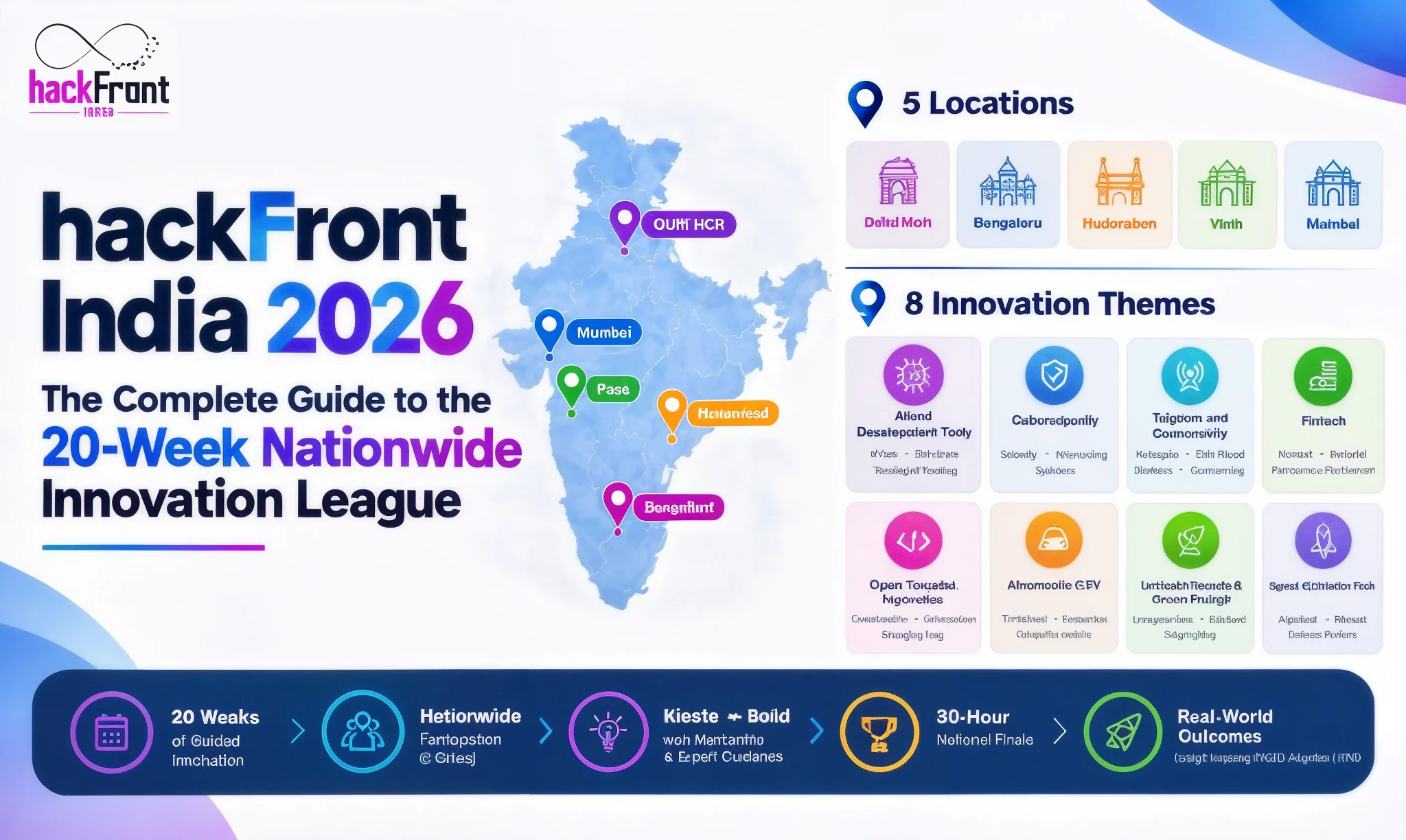
hackFront India 2026: Get the complete guide to eligibility, registration, themes, teams, 20-week format, prizes, sponsors and the national hackathon.
hackFront India 2026 is a 20-week nationwide innovation league run by Where U Elevate for students and early-career builders in India. It spans five talent hubs and eight innovation themes across two sectors - Digital Innovation and Deep Tech & Industry. Participants move through a free, mentor-led cohort built around a real industry brief, a 30-hour national hackathon in Delhi, and an outcomes stage that routes strong teams into hiring, incubation and R&D conversations.
The league's own framing: this isn't a hackathon, it's a season. Everything below follows from that.
hackFront India 2026 at a glance
Detail | hackFront India 2026 |
| Organizer | Where U Elevate |
| Format | Nationwide innovation league |
| Duration | 20 weeks |
| Innovation themes | 8, across 2 sectors |
| Current hubs | Delhi NCR, Mumbai, Bengaluru, Hyderabad, Kolkata |
| Eligibility | Students and early-career builders in India |
| Cohort length | 4 weeks |
| Cohort cost | Free |
| Team size | Solo or team of up to 5 per the Cohorts FAQ |
| National hackathon | 30-hour in-person build |
| National Finale | Delhi; top 200 teams advance, 30 finalists pitch to industry juries |
| Expansion | Five cities today. India tomorrow. - the league expands its map each season |
| Registration | Open |
What is hackFront India 2026?
hackFront India launched at the hackFront India Leadership Forum on 13 June 2026 at the Constitution Club of India, New Delhi - a closed-door gathering of MPs, vice chancellors, CXOs, government officials and startup founders. It's an initiative of Where U Elevate, led by Rishab Ilwadi (Co-Founder & CEO), alongside a named Executive Council covering programme, technology, industry and community functions. The league publishes a Founding Brief that lays out its full model and outcomes pipeline for anyone registering.
Its stated mission: to become India's most impactful innovation league, built on four pillars - industry, academia, startups and government.
Sponsors and Partners Supporting hackFront India 2026
Partner | Role in hackFront India | Relevant area |
| Neo4j | Track Partner | Graph technology, AI, connected data |
| Teliolabs Communications | Track Partner | Technology and connectivity |
| Arduino | Hardware Partner | Hardware, IoT, embedded systems |
| ixigo | Travel Partner | Participant travel ecosystem |
| Sarvam | AI Partner | AI, language technology, AI applications |
| CCoE DSCI | Industry Partner | Cybersecurity and privacy |
| COE- AWRDS | Knowledge Partner | Aerial & Water Robotics, Drones, Autonomous Systems |
| AI Konekt | Media Partner | Connectivity, IoT, private 5G, satellite and multi-carrier networks |
How does hackFront India 2026 work?
The league runs on a three-phase, 20-week arc: Diagnose, Design, Deploy.
Diagnose (Weeks 1–9). Teams pick a theme, take part in campus roadshows, join a cohort with domain mentors, and work a real industry problem brief through to an ideathon submission - the gateway to the national stage.
Why it matters: most hackathon teams lose in the first hour, when they commit to a problem they don't actually understand. This phase forces framing work before anyone starts building.
Design (Weeks 10–11). The top 200 teams advance to the National Finale in Delhi for a 30-hour in-person hackathon, reviewed by the companies that wrote the briefs. Thirty finalists then pitch at the Grand Finale.
Why it matters: you're being judged by the people who actually have the problem, not a generic panel.
Deploy (Weeks 12–20). Hackathon performance activates the outcomes stage - incubation access with corporate labs, a hiring pipeline with sponsor companies, and R&D conversations with brief owners.
What happens in the hackFront India cohort?
The cohort is a free, four-week, mentor-led program tied to your chosen theme
- Week 1 — Problem & Alignment: understand the brief, align as a team, lock the problem statement.
- Week 2 — Idea Structuring: turn that into a defined use case and user flow.
- Week 3 — Solution Design: mentor feedback, feasibility checks, basic architecture.
- Week 4 — Pitch & Ideathon: build the pitch deck, record a demo, present for national qualification.
It runs hybrid - online sessions with in-person roadshow meetups - and you don't need a team walking in; the program helps form one in Week 1. Multiple cohorts run in parallel across the nine-week Diagnose phase.
Who can participate in hackFront India 2026?
Any student, early-career builder and professionals in India can register, with mixed-college teams allowed and no college nomination required.
Question | Direct answer |
| Can students from different colleges team up? | Yes |
| Can I register solo? | Yes - the program helps match or form your team |
| Is college approval needed? | No, registration is open with no SPOC nomination |
| Is the cohort free? | Yes, every seat is fully sponsored |
| Is it online or offline? | Cohort is hybrid; the national hackathon is in-person, in Delhi |
| What's the exact team size cap? | Not settled - the two official FAQs currently say different things (2–5 vs. up to 4). Confirm your final roster size on the registration page before locking your team |
How do I register for hackFront India 2026?
Register directly on the Where U Elevate hackFront India listing - no college nomination needed.
- Confirm eligibility - student, early-career builder or professionals in India.
- Decide solo or team; confirm the current team-size rule on the registration page.
- Pick one theme, using the Theme-Fit Matrix below.
- Complete registration on the Where U Elevate listing and join your cohort.
- Work the four-week program, submit your ideathon, and qualify for the national hackathon.
Colleges can partner with Where U Elevate to host a campus roadshow or anchor a regional cohort; student ambassadors can reach the team at Where U Elevate.
The 8 innovation themes
Digital Innovation
- AI and Developer Tools - AI agents, LLM-powered apps, developer productivity tools
- Cybersecurity - threat detection, fraud prevention, digital identity, secure infrastructure
- Telecom and Connectivity - 5G use cases, network optimization, connectivity for underserved regions
- Fintech - payments, lending, wealth tech, regtech
Deep Tech & Industry
5. Open Source & Innovation - cross-domain problems with no fixed playbook
6. Automobile & EV - EV systems, battery management, autonomous components, smart mobility
7. Critical Minerals & Green Energy - renewable systems, energy monitoring, circular technology
8. Space & Defence Tech - satellite systems, drones, sensor fusion, defence hardware
How should you choose your theme? The Theme-Fit Matrix
This is a self-assessment tool, not an official scoring system. Score each theme 1–5 on:
Factor | Question to ask |
| Skill fit | Can your team build in this domain without starting from zero? |
| Access fit | Can you get the hardware, data or domain advice this theme needs? |
| Brief fit | Can you explain the problem to a non-technical person in two minutes? |
A higher total indicates stronger alignment with your team's current capabilities and access; a lower total suggests you need more preparation first. Don't pick a theme because it sounds impressive - pick one where your skills, access and understanding of the problem actually line up.
hackFront India vs. a traditional hackathon
Factor | Typical short hackathon | hackFront India |
| Preparation | Often minimal, self-directed | 4-week structured cohort with mentors |
| Problem source | Often generic or self-chosen | Real industry briefs |
| Judges | General panel | Companies that wrote the brief |
| Main build | The whole event | One 30-hour stage inside a 20-week league |
| After the event | Certificate, maybe a prize | Hiring, incubation and R&D conversations |
| Access route | Sometimes college nomination | Open registration |
hackFront India vs. Smart India Hackathon
Where U Elevate positions hackFront India as an industry-driven parallel to SIH - a separate competition, not a replacement.
Factor | Smart India Hackathon | hackFront India |
| Organizer | Ministry of Education's Innovation Cell, with AICTE | Where U Elevate |
| Registration path | Typically through college-level selection | Open, no SPOC nomination |
| Problem source | Government and ministry problem statements | Industry problem briefs |
| Duration | Fixed-format national event | 20-week league |
If you didn't clear a college-level SIH round, hackFront India open registration means that isn't a barrier here.
What happens after the hackathon: pathway, not guarantee
hackFront India explicitly builds its later stage around outcomes rather than ending at the trophy.
Published pathway | Not a guaranteed outcome |
| Hiring conversations with sponsor companies | A job offer |
| Incubation access with corporate labs | Incubation acceptance |
| R&D conversations with brief owners | Product deployment or investment |
Top performers get access to these tracks based on performance - it's a route in, not an automatic result.
Who's behind hackFront India?
The league is run by Where U Elevate - Rishab Ilwadi (Co-Founder & CEO), Sunil Kumar (Co-Founder & CTO), Sangya Srivastava (Co-Founder & CXO) and Santosh Maurya (Co-Founder & COO) among others - with an Advisory Council drawing from IIIT Delhi, AutoBridge, Rodim and other industry and academic bodies. Current partners include Neo4j, Arduino, ixigo, CCOE DSCI, Telio Labs, CoE-AWRDS and Konekt AI.
Who is hackFront India best suited for?
Strong fit if you: want to work on real industry problems, want structured mentorship before a build, want to build with a team, are interested in hiring or incubation pathways, and can commit across a multi-week program.
A shorter hackathon may suit you better if you: only have one free weekend, can't take part in the cohort stage, want a purely self-directed build, or prefer picking your own problem over a sponsor brief.
Common mistakes to avoid
- Treating it like a weekend event. Skipping the cohort means arriving at the 30-hour build without a validated problem or plan.
- Picking a theme for prestige. Use the Theme-Fit Matrix instead.
- Submitting old work. Solutions must be built during the league timeline.
- Skipping disclosure. AI tools, open-source frameworks and third-party APIs are allowed - but only if disclosed at submission.
Frequently Asked Questions (FAQs)
1. What is hackFront India 2026?
A 20-week nationwide innovation league by Where U Elevate, with eight themes, a free structured cohort, a national hackathon and post-hackathon pathways into hiring, incubation and R&D.
2. Who can participate in hackFront India 2026?
Students, early-career builders and professionals in India can participate in hackFront India 2026. Registration does not require college nomination, and students from different colleges can form teams together.
3. Is hackFront India 2026 free?
Yes. The four-week hackFront India cohort is free for participants, with seats described by the program as fully sponsored.
4. How do I register for hackFront India 2026?
You can register directly through the Where U Elevate hackFront India listing without a college nomination. Participants should check the registration page for the latest eligibility, dates and team-size requirements before completing registration.
Final take
hackFront India's real difference from a typical hackathon isn't scale - it's sequence. Preparation comes first, then a judged build, then a route toward hiring, incubation or R&D. If you can commit to the cohort stage and pick a theme that fits your team, it's a structured way to work a real industry problem instead of an invented one.
Where U Elevate runs the league and hosts registration - check the hackFront India listing for current dates, the confirmed team-size rule and prize details before you register.
Comments
No comments yet. Be the first to comment!