Hackathon Software Checklist: 12 Features Innovation Managers Must Evaluate (2026)
13 min read
●
18 August 2026
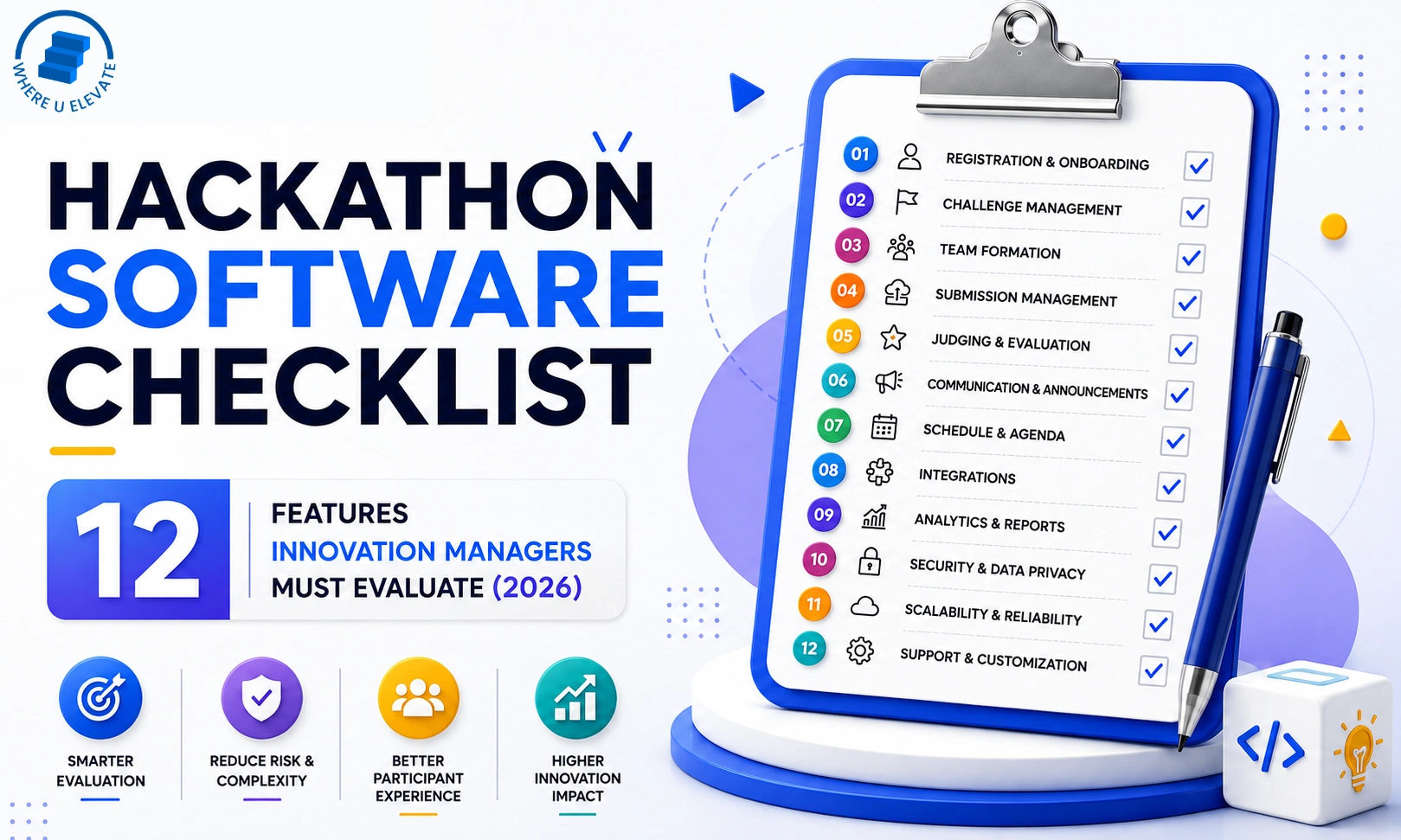
Choosing hackathon software? Use this 12-feature checklist to evaluate platforms, avoid manual work, and find the right solution for your innovation team.
Most hackathon software fails not at launch, but three weeks later - when submissions are due, judges can't find the scoring tab, and someone on your team is manually reconciling scores in a spreadsheet.
That failure is predictable. It happens because most Hackathon Software Checklist compare marketing pages, not operational reality. A platform can look complete in a sales demo and still expose real weaknesses when hundreds of submissions arrive close together, judging runs across multiple rounds, and organizers are coordinating participants in real time.
This checklist asks a different question than most guides. Instead of "what features does hackathon software have," it asks: how should an innovation manager evaluate hackathon software, stress-test a vendor's claims, score competing platforms, and defend that decision internally?
What Is Hackathon Software?
Hackathon software is purpose-built software for managing the operational lifecycle of a hackathon or innovation challenge - from registration and team formation through submissions, judging, results, and reporting. Depending on the platform, the workflow may also extend into ideation, mentorship, communication, analytics, and enterprise governance controls.
Market category research from G2 reflects a similarly broad scope: qualifying products are expected to handle registration through judging and results, support engagement tools like skill-based matching, include ideation features such as idea crowdsourcing, and provide enterprise-grade data protection. That's wider than many buyers assume - a lot of organizers still evaluate hackathon software as a registration tool with a judging tab bolted on, when the category has moved well past that.
Why Most Evaluations Get This Wrong
Innovation managers typically evaluate hackathon software the way they'd evaluate any SaaS tool: pricing, UI, a feature list, maybe a trial. That works for tools used by one team in one steady workflow.
Hackathons don't behave that way. A single event involves several distinct user groups - participants, mentors, judges, organizers, sometimes external stakeholders reviewing shortlists - each hitting the platform hardest during a different, short window. A feature checklist organized by what the tool does misses that. What matters is what happens when it matters most.
The Hackathon Software Fit Model
Four pillars, evaluated together, determine whether a platform holds up:
Participant & Program Experience + Organizer & Workflow Control + Evaluation & Decision Quality + Enterprise Readiness & Outcomes = Platform Fit
Pillar | Core question it answers |
| Participant & Program Experience | Can participants complete the journey without unnecessary friction? |
| Organizer & Workflow Control | Can the team run the event without spreadsheet workarounds? |
| Evaluation & Decision Quality | Can judges produce consistent, defensible decisions? |
| Enterprise Readiness & Outcomes | Can the platform survive organizational scale and prove impact? |
This is Where U Elevate recommended evaluation framework - not an industry-standard scoring system.
Already know your event's scale and judging complexity? Send us those details and we'll tell you where the Fit Model matters most for your specific hackathon. [Talk to the Where U Elevate team →]
Pillar 1: Participant & Program Experience
1. Registration and team formation:- Evaluate whether a participant can register solo and get matched or invited into a team without leaving the platform. Standalone forms typically don't provide native team discovery or matching, which pushes organizers into manual follow-up and participant-side coordination.
2. Submission handling under real conditions:- A disproportionate amount of submission activity tends to happen close to the deadline, so the submission workflow should be tested under peak load - draft-saving, file re-uploads, partial submissions - not just demonstrated with a handful of sample projects in a calm sales call.
3. In-platform communication:- If participants have to jump to a separate Discord or WhatsApp group for every announcement, the event is fragmented across tools. Look for in-platform announcements, mentor-request queues, and Q&A.
4. Mentorship support:- Mentorship support is an important differentiator between registration-focused tools and platforms designed to support the broader innovation workflow. If mentors need to be assigned to teams, reachable in real time, and tracked for engagement, confirm the platform handles that natively.
Pillar 2: Organizer & Workflow Control
5. Configurable workflows, not fixed templates:- Every hackathon format differs - internal innovation sprints, student competitions, multi-stage corporate challenges. A platform that forces one rigid workflow pushes exceptions back into spreadsheets, which defeats the point of using software.
6. Challenge and problem-statement management:- For enterprise and multi-track events, organizers need to publish, categorize, and route submissions against specific problem statements or tracks - not just collect one undifferentiated submission pool.
7. Bulk actions, data export, and integrations:- Can you bulk-approve registrations, bulk-message a shortlist, and export clean data mid-event, not just after? For organizations with an existing stack, check whether the platform integrates with tools like Slack, Teams, or an ATS rather than requiring manual data transfer.
8. Role-based access control:- Volunteers, judges, and core organizers need different permission levels. Without granular roles, a platform either blocks volunteers from tasks they need to do, or exposes data - including judge scores - that shouldn't be visible to them.
Pillar 3: Evaluation & Decision Quality
9. Weighted, customizable scoring rubrics:- Judging by gut feeling doesn't scale past a handful of submissions. Vendors purpose-built around judging - HackHQ, for one, publicly documents weighted rubric scoring, judge assignment, live progress, and automatic winner calculation as core features - differentiate specifically on this. If a platform's judging is a single free-text comment box, that's the gap to press on.
10. Conflict-of-interest and bias controls:- Can you exclude a judge from scoring their own team, or a team they mentored? This is a baseline integrity requirement for corporate and academic hackathons.
11. Multi-round judging with automatic shortlisting:- When submission volume is high, organizations may use multiple judging rounds to narrow the field before final evaluation. Confirm the platform supports automatic shortlisting between rounds, rather than requiring organizers to manually recompile lists.
Judging is one of the easiest capabilities to underestimate during a software evaluation, because a polished demo can hide the complexity of real evaluation workflows - mixed judge availability, tie-breaking, weighted criteria that need to change mid-event. Ask to see it working with a populated rubric and real sample data, not a screenshot.
Pillar 4: Enterprise Readiness & Outcomes
12. Security, scale, and reporting that map to leadership's questions
- Scale: Scale should be evaluated using evidence from comparable events, not a vendor's theoretical maximum. For example, Reskilll publicly describes large-scale hackathon programs involving tens of thousands of registrations across events in the Indian market. Use examples like this as a benchmark when asking another vendor to demonstrate comparable capacity - not as a claim about which vendor is better.
- Security: For corporate and government hackathons, participant data needs real data-protection practices, not a generic privacy page. Some vendors make this explicit - Brightidea, for example, publicly markets SOC 2 Type II certification, AES-256 encryption, and SSO support for its hackathon offering. These are vendor-published claims; procurement teams should request the underlying security documentation and confirm the controls apply to the specific product and deployment being purchased, not just the vendor's brand generally.
- Reporting: Registration counts alone don't satisfy a leadership question about ROI. Look for analytics on participation-to-completion rates and judge-scoring distributions - the data that supports a "here's what this delivered" conversation afterward.
The Hackathon Software Stress Test
Don't ask vendors whether the hackathon platform supports a workflow. Ask them to demonstrate it, live, with these five scenarios:
- Deadline spike — 200 participants submit in the final 30 minutes. Does the system hold, and can participants confirm their submission went through?
- Judge conflict — Judge A cannot evaluate Team 17. Can that exclusion be set without manual workarounds?
- Multi-round evaluation — 300 submissions narrow to 50 finalists, then to 10 winners. Is shortlisting automatic, or does someone recompile lists by hand?
- Permission isolation — A volunteer can approve participant registrations but cannot see judge scores. Is that actually enforced, or just described?
- Executive reporting — Generate a report showing participation, submissions, evaluation activity, and winners, in a format a non-technical stakeholder can read without explanation.
A vendor who can demonstrate all five lives gives you substantially stronger evidence than a vendor who can only describe them.
Want to see the Stress Test run live on Where U Elevate platform? We'll walk through all five scenarios with your actual event parameters - no generic demo script. [Book a stress-test walkthrough →]
How to Compare Hackathon Software Vendors
Not every platform is solving the same problem. Broadly, current vendors cluster into a few types - though these categories overlap, and a single vendor may combine several models:
Platform type | Best suited for | Strength | What to verify |
| Purpose-built hackathon platform | Structured, standalone competitions | End-to-end event workflow | Enterprise governance controls |
| Innovation-management platform | Enterprise programs running hackathons as one activity among several | Ideation + broader innovation lifecycle | Hackathon-specific judging depth |
| Judging-first platform | Events where judging is the operational bottleneck | Weighted rubrics, fast live scoring | Registration and team-formation depth |
| Fully managed / end-to-end service | Organizations that want platform plus operational execution | Scale, mentor networks, hands-off delivery | Software configurability if requirements change |
| Forms + spreadsheets | Very small, single-round internal events | Low cost, familiar tools | Weak fit once multiple teams, judging rounds, or structured reporting are required |
Buyer Reality: What to Prioritize by Situation
If your situation is... | Prioritize |
| Small internal sprint | Ease of setup, submission handling |
| Large corporate hackathon (hundreds of participants) | Scale, workflow configurability, permissions |
| Multiple judging rounds | Rubrics, judge assignment, automatic shortlisting |
| External or guest judges | Judge-side UX, access control, conflict-of-interest handling |
| Student or campus hackathon | Registration, team formation, communication |
| Enterprise innovation challenge | Security, governance, analytics |
| Public or open challenge | Scale, onboarding, communication at volume |
| Executive-sponsored program | Reporting, outcome measurement, ROI narrative |
Hackathon Software Fit Score
For platforms that clear your non-negotiables, score each pillar 1–5 based on a live demo and a completed stress test - not marketing copy.
Pillar | Weight |
| Participant & Program Experience | 25% |
| Organizer & Workflow Control | 25% |
| Evaluation & Decision Quality | 30% |
| Enterprise Readiness & Outcomes | 20% |
Weighted score = Σ (pillar score ÷ 5 × pillar weight), expressed out of 100.
- 85–100: Strong fit
- 70–84: Evaluate gaps before committing
- 55–69: Significant operational risk for anything beyond a small, single-round event
- Below 55: Poor fit for complex programs
These thresholds are Where U Elevate recommended decision bands, not an industry-standard certification. Judging carries the highest weight deliberately - it's the pillar most visible risk sits in relative to how little of it a standard demo shows.
Before You Score: Identify Your Non-Negotiables
Not every requirement should be part of a weighted average. Some requirements are pass/fail. Before scoring anything, list your non-negotiables - for example:
- SSO required
- A specific data residency requirement
- Multi-round judging required
- API access required
- A minimum participant capacity
- External judge access required
- Private or internal-only event required
If a platform fails a non-negotiable, exclude it before calculating the Fit Score below. A vendor shouldn't score 92/100 by performing brilliantly everywhere while failing the one requirement you can't compromise on - that's not a small deduction, it's a disqualification.
Why Trust This Checklist?
Where U Elevate has operated hackathon and innovation programs across academia, enterprise, and public-sector ecosystems, including large-scale cybersecurity and city-scale AI innovation initiatives. This checklist reflects operational requirements observed directly across registration, submissions, judging, participant engagement, and reporting - not a vendor feature inventory assembled from outside the category.
Operational observation: When evaluation criteria, reviewer assignment, and result aggregation live in separate systems, the workload doesn't disappear - it moves to the organizer. In multi-round programs, that cost shows up as manual reconciliation, judge follow-up, and result validation after the event should already be over. That's why evaluation workflow should be tested as one end-to-end process during vendor evaluation, rather than assessed as a standalone "judging" feature on a spec sheet.
Case reference: Where U Elevate was a named platform partner for the Great AppSec Hackathon 2024, run by the Telangana Cybersecurity Bureau (TGCSB) with the Cybersecurity Centre of Excellence (CCoE) and DSCI - a 24-hour Capture the Flag competition. Independent event coverage confirmed the event drew 10,000+ registrations from 24 states, 3 union territories, and roughly 20 countries, run across a screening round and a live CTF round. [https://whereuelevate.com/success-stories/great-appsec-hackathon-2024-ccoe-dsci-x-govt-of-telangana]
Where U Elevate platform has also supported large-scale program work more broadly - its own published materials describe enabling 6.5 lakh+ evaluations and judgements on the platform to date, which reflects the kind of evaluation volume this checklist's judging pillar is written to handle. (Where U Elevate is also listed among the innovation partners for the Delhi AI Grind city-wide initiative; use platform-wide figures here rather than event-specific participant counts for that program until a dedicated case study with verified numbers is published.)
Have a Hackathon You're Actually Planning?
Send us your participant volume, challenge tracks, judging rounds, and reporting requirements. We'll map those against the hackathon workflow and identify which capabilities are essential, which are optional, and where operational risks may appear.
[Get a hackathon workflow assessment →]
Hackathon Software Checklist at a Glance
- Evaluate hackathon software using the Hackathon Software Fit Model: Participant & Program Experience + Organizer & Workflow Control + Evaluation & Decision Quality + Enterprise Readiness & Outcomes
- Identify non-negotiables and exclude any platform that fails them before scoring
- Run the Hackathon Software Stress Test (deadline spike, judge conflict, multi-round evaluation, permission isolation, executive reporting) before signing
- Evaluation and judging carries the most weight in the Fit Score - it's the pillar with the least visibility in a standard demo
- Ask for concrete evidence - comparable event scale, named security certifications, a live judging demo - rather than accepting stated capabilities
What features should hackathon software have?
Hackathon software needs strength across four areas: participant and program experience (registration, submissions, mentorship, communication), organizer and workflow control (configurable workflows, challenge management, bulk actions, role-based access), evaluation and decision quality (weighted rubrics, conflict-of-interest controls, multi-round shortlisting), and enterprise readiness (proven scale, real security posture, reporting that maps to leadership questions). and Where U Elevate has all these features already.
Key Takeaways
- Evaluate hackathon software against the moments it's tested hardest, not a static feature list
- Identify non-negotiables and use them as a pass/fail gate before scoring anything
- Use the four-pillar Fit Model and weight Evaluation & Decision Quality highest
- Run the five-scenario stress test live with any vendor before committing
- Match priorities to your buyer-reality row rather than a generic "best platform" list
Vendor Comparison Table
Evaluation area | What to test | Evidence to request | Red flag |
| Registration | Custom eligibility + approval flow | Live workflow demo | Relies on external spreadsheet |
| Team formation | Solo → team matching | Live demonstration | Manual matching only |
| Submission | Draft + revision handling | Test submission under load | Single-session upload only |
| Judging | Weighted, customizable rubric | Live judge-side demo | Spreadsheet-based scoring |
| Multi-round | 300 → 50 → 10 shortlisting | Workflow demonstration | Manual list recompilation |
| Permissions | Judge/volunteer isolation | Role-based access test | Shared admin access |
| Scale | Comparable event evidence | Named reference event | Vague "unlimited" claim |
| Reporting | Executive-readable report | Sample report | Raw CSV export only |
| Security | Named certifications, SSO | Security documentation | Generic privacy-policy page only |
| Integrations | Fit with existing stack | API or export demo | Manual data transfer only |
Frequently Asked Questions (FAQ)
1. What features should hackathon software have?
Hackathon software should cover registration, team formation, submissions, judging, communication, workflows, permissions, reporting, and integrations. For enterprise programs, also evaluate scalability, security, and multi-round evaluation.
2. How do I choose the right hackathon software?
Choose hackathon software by matching the platform to your event size, judging complexity, workflow requirements, security needs, and reporting requirements. Test those requirements in a live vendor demo rather than comparing feature lists alone.
3. What should I test in a hackathon software demo?
Test five workflows: peak-volume submissions, judge conflicts, multi-round shortlisting, role-based permissions, and post-event reporting. Ask the vendor to demonstrate each workflow using realistic sample data rather than explaining how the feature works.
4. Can hackathon software handle large-scale events?
It can, but capacity should be evaluated using evidence from comparable events rather than a vendor's stated participant limit. Ask about concurrent users, submission-volume handling, peak traffic, infrastructure, and previous events at a similar scale.
Comments
No comments yet. Be the first to comment!