From 70 to 700 Teams: How One Hackathon Scaled
7 min read
●
26 March 2026
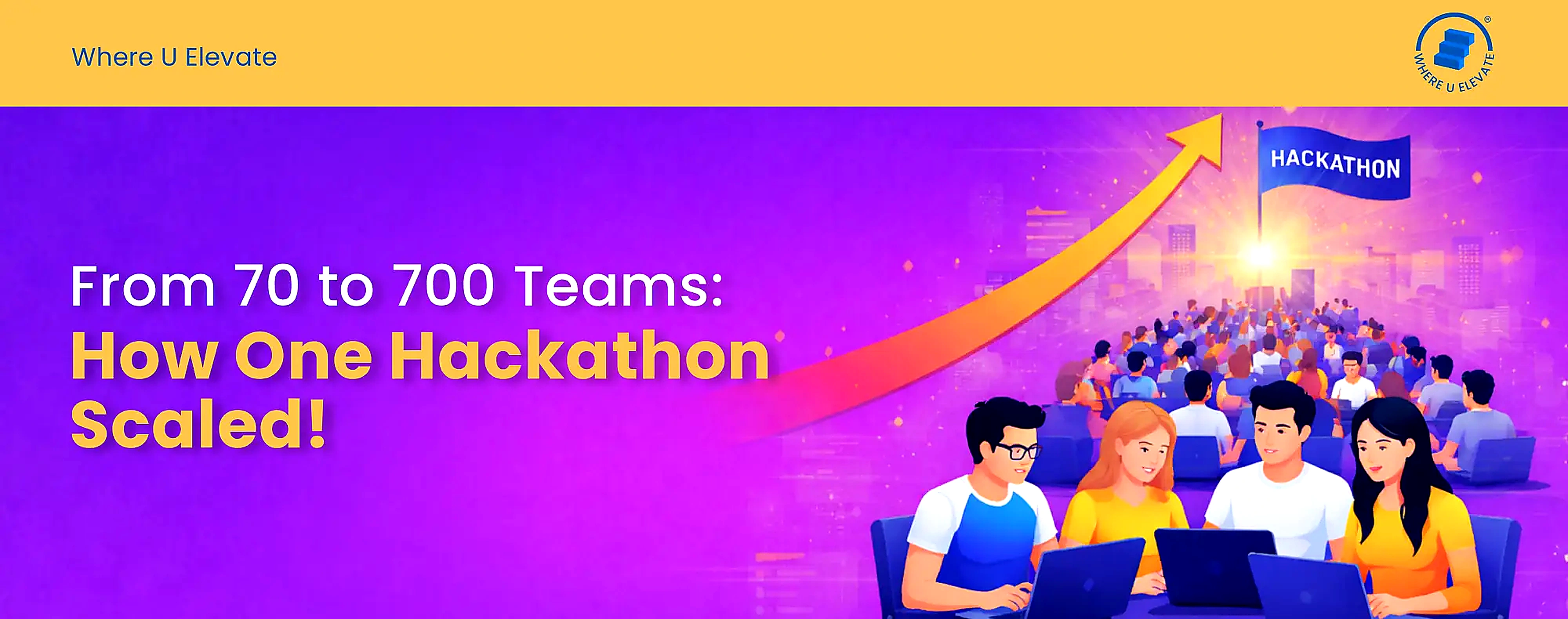
Learn the exact hackathon scaling strategy that grew an event from 70 to 700+ teams. Discover how to scale a hackathon using a powerful hackathon management platform like Where U Elevate.
How one community stopped managing chaos and started building infrastructure — and what your organization can steal from their playbook.
Running a hackathon with seventy teams feels exciting and manageable. Organizers know most mentors personally, submissions are easy to track, and communication flows naturally. But the moment participation jumps to hundreds of teams, the entire system starts to break.
This is exactly what happened when the Delhi AI Grind community experienced rapid growth. Registrations exploded, interest surged, and within a short time the event went from 70 teams to more than 700 teams.
What looked like a success story at first quickly exposed a serious challenge: the event infrastructure was not designed to support that level of scale.
The organizers realized something critical that most hackathon guides never discuss — scaling a hackathon is not a marketing problem. It is a systems problem.
This is the playbook they used to build a real hackathon scaling strategy, and how platforms like Where U Elevate made that growth sustainable.
The Hidden Problem Most Hackathons Face When They Grow
Many organizers believe the hardest part of running a hackathon is attracting participants. In reality, the bigger challenge begins after registrations increase.
When participation scales, several operational problems appear at the same time:
- Participant onboarding becomes slow and inconsistent
- Communication channels become overloaded with repetitive questions
- Mentors struggle to track which teams they are helping
- Judges face hundreds of submissions without a structured evaluation process
- Organizers spend more time managing logistics than building community
Without the right infrastructure, even successful hackathons begin to feel chaotic.
This is why organizations searching how to scale a hackathon must focus on systems rather than promotion alone.
Why Hackathon Growth Requires Infrastructure, Not Just Marketing
Before solving their operational issues, the Delhi AI Grind organizers made the same mistake many communities make.
They focused on increasing visibility:
- More outreach to universities
- More social media promotion
- More partnerships with developer groups
Registrations increased quickly. But operational complexity increased even faster.
The turning point came when the organizing team reframed the problem.
Instead of asking:
How do we get more teams?
They started asking:
How do we support ten times more teams without ten times more work?
That shift from promotion to infrastructure is the foundation of every effective hackathon scaling strategy.
The Four Systems That Scaled the Hackathon from 70 to 700 Teams
Scaling did not happen through a single decision. It required redesigning the entire operational model around four critical systems.
1. Centralized Operations Through a Hackathon Management Platform
Initially, the event relied on scattered tools:
- Google Forms for registrations
- WhatsApp for team formation
- Email for submissions
- Spreadsheets for judging
Every tool created friction. Every handoff created errors.
The solution was moving everything onto a dedicated hackathon management platform.
With a centralized platform, organizers could manage:
- Registrations
- Team creation
- Project submissions
- Mentor scheduling
- Judging workflows
This dramatically reduced manual coordination and gave organizers a clear view of the entire event.
Platforms like Where U Elevate provide exactly this kind of structured infrastructure, allowing hackathon organizers to manage hundreds of teams from a single dashboard.
2. Automated Communication at Scale
Communication becomes the biggest operational bottleneck as participation grows.
At seventy teams, organizers can respond to questions manually.
At seven hundred teams, manual responses become impossible.
The solution was building automated communication systems.
Participants received:
- Automated onboarding messages
- Timeline reminders
- Submission alerts
- Resource updates
These updates were delivered through the hackathon management platform instead of individual messages.
The impact was immediate.
Participant questions decreased significantly because information was delivered proactively.
3. Structured Judging for Hundreds of Projects
Judging is one of the most sensitive aspects of a hackathon.
When evaluation criteria are unclear, participants feel the results are unfair.
To prevent this problem at scale, the organizers implemented structured evaluation systems.
Each project was evaluated using predefined criteria such as:
- Innovation
- Technical execution
- Problem relevance
- Impact potential
Judges used digital scoring dashboards instead of spreadsheets, ensuring consistency across hundreds of submissions.
This system allowed 40 judges to evaluate projects efficiently without overwhelming workloads.
4. Mentor Infrastructure Instead of Ad-Hoc Support
Scaling mentorship requires more than inviting additional mentors.
Without clear coordination, large mentor groups create confusion instead of support.
To solve this, mentors were onboarded through a structured process.
Each mentor received:
- Defined expectations
- Assigned team cohorts
- Scheduled mentoring sessions
Instead of reacting to random requests, mentors worked within an organized support system.
The result was a strong mentor network that supported 85 mentors and hundreds of teams effectively.
The Results: From 70 Teams to 700+
Once these systems were implemented, the event scaled rapidly without operational breakdown.
The growth metrics tell the story clearly.
Metric | Early Event | Scaled Event |
| Teams | 70 | 700+ |
| Judges | 8 | 30+ |
| Coordination | Mostly manual | Highly automated |
| Participant experience | Inconsistent | Structured |
More than 700 teams were created through the Delhi AI Grind community using the Where U Elevate platform, demonstrating how the right infrastructure enables rapid growth.
How to Scale a Hackathon Without Operational Chaos
Organizations planning large innovation events often ask the same question:
How to scale a hackathon without overwhelming the organizing team?
The answer almost always includes three key steps:
Build systems before growth arrives
If your event targets 200 teams, design infrastructure capable of supporting 500.
Use a dedicated hackathon management platform
Manual coordination cannot support large developer communities.
Standardize processes early
Judging, mentorship, communication, and submissions should follow structured workflows.
These principles are the foundation of a successful hackathon scaling strategy.
Why Scalable Hackathons Matter for Universities and Companies
Hackathons are no longer simple student competitions.
For many organizations, they are powerful innovation tools.
Universities use them to build strong technology communities.
Companies use them to discover talented developers and validate new ideas.
Developer communities use them to grow ecosystems around emerging technologies.
However, these benefits only appear when participation reaches meaningful scale.
A well-designed hackathon management platform allows events to grow while maintaining high participant experience.
Why Infrastructure Determines Sponsor Confidence?
Sponsors and industry partners evaluate hackathons based on operational quality.
An event that runs smoothly signals professionalism and reliability.
An event that appears disorganized discourages future partnerships.
When organizers demonstrate structured infrastructure, sponsors gain confidence that their brand will be represented professionally and their challenges will be managed effectively.
This is why scalable hackathons attract stronger sponsors and larger industry participation.
The Future of Hackathons Is Scalable Ecosystems
The most successful communities are beginning to view hackathons differently.
Instead of treating them as single events, they see them as long-term ecosystem infrastructure.
Each hackathon generates:
- new developers
- mentor networks
- sponsor partnerships
- innovation data
When events are managed through scalable platforms, this data compounds year after year, creating a powerful innovation ecosystem.
Ready to Scale Your Next Hackathon?
If your organization plans to grow its next hackathon beyond a few dozen teams, infrastructure must come before promotion.
A strong hackathon scaling strategy combined with the right hackathon management platform allows organizers to expand participation without increasing operational complexity.
Platforms like Where U Elevate provide the systems needed to run large developer events — including registrations, team formation, automated communication, structured judging, and analytics.
The success of the Delhi AI Grind community, where more than 700 teams were created through the Where U Elevate platform, proves what becomes possible when strong communities meet scalable infrastructure.
If your university, company, or developer community wants to run a hackathon that grows from 70 teams to 700 teams and beyond, it starts with building the right systems today.
Explore how Where U Elevate can support your next innovation event and turn your hackathon into a scalable engine for talent discovery, community growth, and technological innovation. 🚀
Frequently Asked Questions (FAQs)
1. How do you increase hackathon registrations?
Increasing hackathon registrations requires strong promotion across student communities, clear incentives, early partnerships with universities, and an easy registration process. Marketing through developer communities, social media, and campus ambassadors also plays a major role.
2. Why do many hackathons struggle to get participants?
Many hackathons fail to attract participants due to poor marketing, unclear value for participants, complicated registration processes, or lack of industry partnerships that add credibility and incentives.
3. What marketing strategies work best for hackathons?
Effective hackathon marketing includes campus ambassador programs, partnerships with student communities, social media campaigns, developer forums, email campaigns, and collaborations with tech organizations.
4. What platforms help manage large hackathons efficiently?
Hackathon management platforms like Where U Elevate help organizers handle registrations, submissions, judging workflows, mentor coordination, and communication at scale.
Comments
No comments yet. Be the first to comment!