7 Mistakes That Kill Hackathon Registrations
7 min read
●
30 March 2026
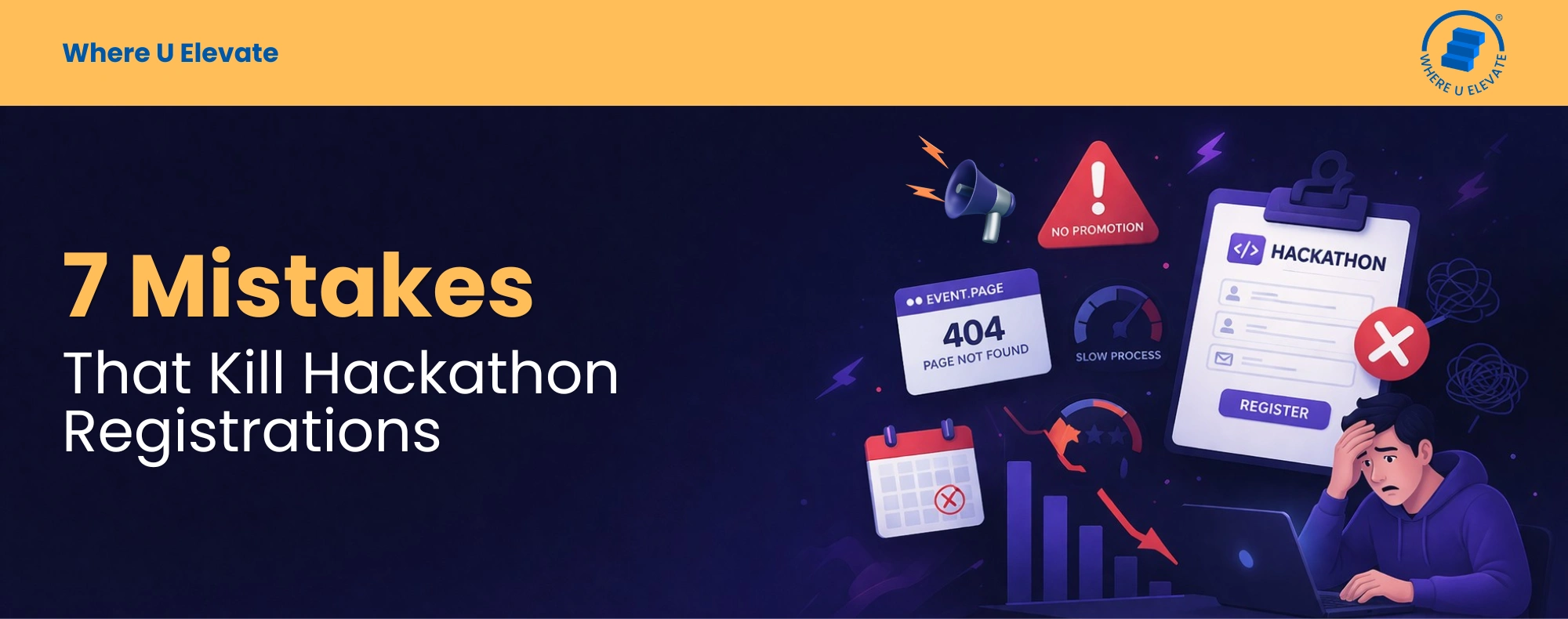
Hackathon registrations low? 7 costly mistakes killing participation—and how companies fix them to attract developers, boost sign-ups, and fill hackathons faster.
You planned the theme.
You secured sponsors.
Your hackathon page went live.
Then you checked the dashboard — and the hackathon registrations were barely moving.
This situation is far more common than most organizers expect. Companies invest weeks planning innovation challenges, yet struggle to attract the developer participation they need.
The reality is simple: hackathons rarely fail because of the idea. They fail because of distribution and execution gaps.
For companies running hackathons for hiring, innovation, or brand awareness, understanding why hackathons fail to attract participants is critical.
This guide breaks down the seven most common hackathon registration mistakes — and the proven strategies leading organizations use to fix them.
Why Hackathon Registrations Fail (Quick Summary)
Most hackathon registrations drop due to seven common issues:
- weak promotion and visibility
- unclear value proposition
- complicated registration process
- lack of developer community outreach
- generic event positioning
- no pre-event engagement strategy
- using platforms without built-in distribution
When organizers fix these areas, registration numbers increase dramatically.
The Real Opportunity Behind Hackathons
Hackathons are not just community events. For companies, they are powerful growth and hiring tools.
Recent industry research highlights their impact:
- 68% of hackathons attract fewer than 100 participants
- Hackathon participants convert to hires 3.2x more often than traditional applicants
- 40% of developers discover employers through hackathons or coding challenges.
The opportunity is massive.
The difference between a hackathon with 70 registrations and one with 700 usually comes down to strategy.
Mistake 1: Weak Promotion and Limited Visibility
Many organizers assume a good hackathon will promote itself.
It will not.
Developers are exposed to dozens of events every week. If your hackathon is not consistently visible across multiple channels, it disappears into the noise.
What weak promotion looks like
- One announcement on LinkedIn
- A single email to your mailing list
- No presence in developer communities
- Promotion starting only two weeks before the event
This approach almost always results in low hackathon registrations.
The Fix: Multi-Channel Distribution
High-performing hackathons use layered promotion strategies including:
- developer communities
- campus coding clubs
- LinkedIn and Twitter outreach
- tech newsletters
- hackathon platforms
Platforms like Where U Elevate help companies solve this distribution challenge by connecting hackathons directly to active developer communities and university networks.
Instead of starting promotion from zero, organizations gain immediate access to a large pool of potential participants.
Mistake 2: A Value Proposition That Says Nothing
Many hackathon pages use messaging like this:
Join our exciting innovation hackathon and win amazing prizes.
To developers, this means almost nothing.
Before registering, developers evaluate whether the event is worth their time.
The four questions every developer asks
- What real problem will I solve?
- Will this improve my portfolio or career prospects?
- Are the prizes meaningful?
- Will industry experts or hiring managers be involved?
If your event page does not answer these questions quickly, participants leave.
The Fix: Outcome-First Messaging
Compare these two examples.
Weak message
Participate in our AI hackathon and compete for prizes.
Strong message
Build AI tools to detect financial fraud alongside engineers from our payments team. Top teams get fast-tracked interview opportunities.
The second version clearly explains:
- the challenge
- the benefit
- the career opportunity
Clarity dramatically increases hackathon registrations.
Mistake 3: A Complicated Registration Process
Registration friction quietly destroys participation.
Many hackathon organizers create forms with too many required fields, file uploads, and verification steps before someone can even register.
Common Hackathon registration mistakes
- forms with 10+ required fields
- mandatory team creation before sign-up
- resume uploads during initial registration
- poor mobile experience
Research from Typeform shows that form completion rates drop about 11% for every additional field added after the first three.
That means complex forms can eliminate the majority of potential participants.
The Fix: Progressive Registration
Collect only essential information initially:
- name
- institution or company
- area of interest
Additional details can be gathered later through follow-up forms.
This simple change alone can dramatically increase hackathon registrations.
Mistake 4: Ignoring Developer Communities
Developers rarely discover hackathons through random advertisements.
They discover them through communities they trust.
These include:
- university coding clubs
- developer Discord servers
- GitHub communities
- campus ambassador networks
- tech student organizations
When organizers ignore these networks, they lose access to thousands of potential participants.
Platforms like Where U Elevate already maintain strong connections with developer communities and institutions, helping companies reach these audiences faster.
For organizations without established campus relationships, this ecosystem can significantly accelerate hackathon registrations.
Mistake 5: Generic Positioning That Makes Your Event Forgettable
Developers see many hackathon announcements every week.
If your event sounds like every other hackathon, it will be ignored.
Example of weak positioning
AI Innovation Hackathon 2025
Example of strong positioning
Build AI tools that help rural healthcare workers detect diseases faster.
The second example communicates a real problem with real impact.
The Fix: Problem-First Positioning
Successful hackathons focus on meaningful challenges rather than generic themes.
Problem-focused positioning:
- attracts developers passionate about the domain
- creates a stronger narrative for promotion
- signals deeper organizational expertise
This makes the event stand out and increases registrations.
Mistake 6: Registrations Without Engagement
Many organizers focus entirely on collecting registrations but forget to maintain participant excitement before the event begins.
Without engagement, participants lose interest and fail to show up.
Typical hackathons without engagement see show-up rates between 30% and 50%.
The Fix: Pre-Event Engagement
Smart organizers maintain communication with participants through:
- welcome emails
- community discussion groups
- mentor introductions
- technical preparation sessions
- team formation opportunities
A blockchain company using this approach achieved an 84% participation rate during their hackathon.
Engagement converts registrations into active participants.
Mistake 7: Choosing a Platform Without Distribution
Some event platforms only provide a registration page.
They do not help with promotion, community reach, or engagement.
This forces organizers to build visibility entirely on their own.
What an effective hackathon platform should provide
- Access to developer communities
- University and campus networks
- Simple registration experience
- Promotional support
- Real-time analytics
Where U Elevate was designed to address these challenges by connecting hackathons with a large network of developers and students.
For companies running hackathons to discover talent or generate innovation ideas, this ecosystem significantly increases event reach and participation.
Case Study: How a FinTech Company Increased Registrations by 420%
A fintech company launching a security-focused hackathon initially struggled with promotion.
Their early campaign relied primarily on LinkedIn announcements and internal emails.
After shifting their strategy they:
- partnered with university coding clubs
- simplified the registration form
- promoted the event through developer communities
- used a hackathon distribution platform
Within six weeks, hackathon registrations increased by over 420%, and the event attracted hundreds of developers across multiple institutions.
The lesson is clear: distribution strategy determines success.
The Hackathon Registration Funnel
Successful organizers think about hackathons as a funnel rather than a single event page.
Each stage must be optimized.
Awareness
Developers discover the event through communities, social channels, and hackathon platforms.
Interest
A clear value proposition motivates them to learn more.
Registration
A simple sign-up process converts interest into participation.
Commitment
Pre-event engagement ensures participants actually attend.
Advocacy
A strong experience encourages participants to recommend future events.
When every stage works together, hackathon registrations grow consistently.
Ready to Run a Hackathon That Actually Attracts Developers?
The companies that consistently achieve hundreds of hackathon registrations are not simply promoting harder. They are using stronger distribution strategies and developer ecosystems.
Where U Elevate helps organizations connect with developer communities, universities, and early-career engineers through structured innovation challenges and hackathons.
If your company is planning a hackathon for hiring, innovation, or brand visibility, the right infrastructure can dramatically increase participation and results.
Book a free hackathon strategy call with Where U Elevate to design a distribution plan tailored to your target developer audience.
Instead of struggling with low visibility and slow registrations, you can launch a hackathon that attracts the talent and ideas your organization is looking for.
Frequently Asked Questions (FAQs)
1. Why are hackathon registrations low?
Hackathon registrations are usually low due to weak promotion, unclear value for developers, complicated registration forms, and lack of outreach to developer communities.
2. How do you increase hackathon registrations?
To increase hackathon registrations, organizers should improve promotion, simplify the sign-up process, partner with developer communities, and clearly communicate the value participants will gain.
3. Why do hackathons fail?
Hackathons fail when organizers ignore distribution, do not engage developer communities, use generic themes, and fail to maintain participant engagement before the event.
4. How do companies promote hackathons?
Companies promote hackathons through developer communities, university partnerships, social media campaigns, tech newsletters, and hackathon platforms that reach active developers.
Comments
No comments yet. Be the first to comment!