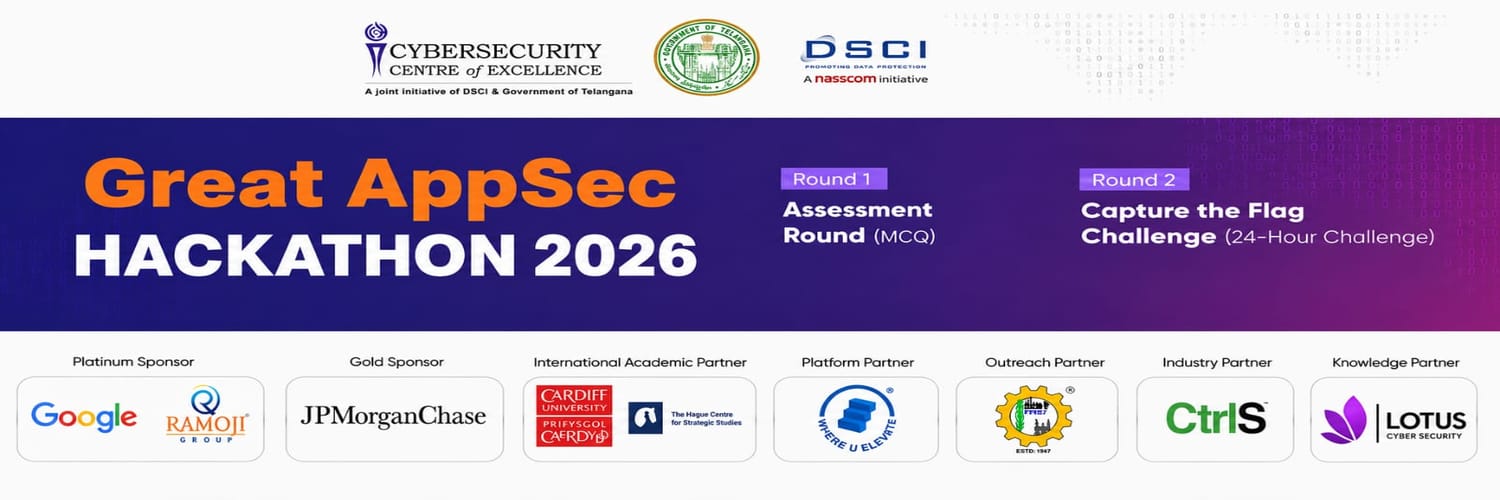
The Great AppSec Hackathon 2026, conducted by the Cybersecurity Centre of Excellence, Telangana, India, is an international hackathon open to students from all countries, aimed at nurturing talent in application security (AppSec), building cybersecurity skills and boosting global collaboration in securing the digital ecosystem. Scheduled for August – September 2026, the hackathon brings together the brightest young minds across undergraduate and postgraduate backgrounds — B.Tech, M.Tech, M.Sc., B.Sc., MCA and BCA — in both tech and non-tech disciplines, to test their skills in real-world scenarios through gamified challenges.
The programme is backed by a coalition of global technology, financial, academic and cybersecurity leaders — Google and Ramoji Group (Platinum Sponsors), JPMorganChase (Gold Sponsor), Cardiff University and The Hague Centre for Strategic Studies (International Academic Partners), Where U Elevate (Platform Partner), FTCCI (Outreach Partner), CtrlS (Industry Partner) and Lotus Cyber Security (Knowledge Partner) — bringing world-class engineering depth, academic rigour and industry reach to the initiative. The 2024 edition drew more than 10,000 registrations from over 20 countries and from every State and Union Territory of India.
Why Application Security:
Security is not the responsibility of cybersecurity experts alone. Every developer, engineer and IT professional should build security and privacy by design into their work.
- 8.9 — Average vulnerabilities found per mobile app Across more than 2 million apps each on Android and iOS, many findings are rated high or critical — and roughly 55% of apps fail to reach market for want of adequate security and privacy safeguards.
- 30% — of breaches now involve a third party Double the previous year's 15%. Exploitation of vulnerabilities is the second-largest initial access vector at 20% of breaches, up 34% year on year. Source: Verizon 2025 Data Breach Investigations Report
- $4.99M — Global average cost of a data breach A 12% rise year on year and a record high, driven by higher detection, escalation and lost-business costs — underscoring the need for trained professionals to mitigate risk. Source: IBM Cost of a Data Breach Report 2026
By addressing application vulnerabilities early, organisations avoid outages, data breaches, regulatory exposure and lasting brand damage — and that begins with how the next generation of engineers is trained.
What this initiative is designed to do:
- Create awareness of application security threats and vulnerabilities.
- Equip students with practical, hands-on skills in cybersecurity.
- Provide Indian students with internship and job opportunities through industry partnerships.
- Help organisations discover, assess and attract the right cybersecurity talent.
- Strengthen the cybersecurity quotient of the global digital ecosystem.
Pre-Hackathon Webinars:
A series of expert-led sessions delivered by professionals from CCoE and DSCI will prepare participants with hands-on training in application security ahead of the competition — so that students arrive at Round 1 equipped, not guessing.
Objectives:
- Create awareness of threats and vulnerabilities in application security.
- Use a gamified learning approach to foster skill-building.
- Provide internship and job opportunities for Indian students demonstrating merit.
- Encourage international student participation to foster global knowledge exchange.
- Boost the cybersecurity quotient of the ecosystem through collaboration.
Eligibility:
- Open to students worldwide pursuing Degree in any discipline (B.Tech, M.Tech, MCA, BCA, B.Sc., M.Sc. etc).
- Internships and job opportunities are exclusively for Indian nationals studying in India.
Registration:
The Great AppSec Hackathon – 2026 is a unique opportunity for students across the globe to learn, compete, and showcase their skills in application security. By bringing global participation the hackathon aims to serve both as a global knowledge platform and a career launchpad.
Note: Please register and create a login using your own personal credentials, since the same creds/logins will be used consistently across all rounds, including MCQ and CTF